Monday, 21 March 2016

Real-Time Web Log Analyzer

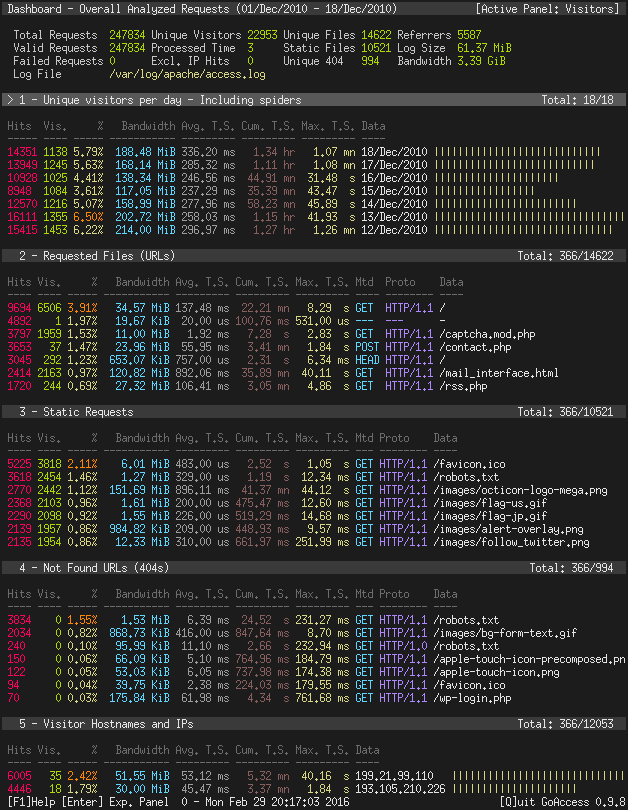
GoAccess is an open source real-time web log analyzer and interactive viewer that runs in a terminal in *nix systems. It provides fast and valuable HTTP statistics for system administrators that require a visual server report on the fly.  


GoAccess Main Dashboard

Features

GoAccess parses the specified web log file and outputs the data to the X terminal. Features include:
  • General statistics, bandwidth, etc.
  • Time taken to serve the request (useful to track pages that are slowing down your site)
  • Metrics for cumulative, average and slowest running requests
  • Top visitors
  • Requested files & static files
  • 404 or Not Found
  • Hosts, Reverse DNS, IP Location
  • Operating Systems
  • Browsers and Spiders
  • Referring Sites & URLs
  • Keyphrases
  • Geo Location - Continent/Country/City
  • Visitors Time Distribution
  • HTTP Status Codes
  • Metrics per Virtual Host
  • Ability to output HTMLJSON and CSV
  • Tailor GoAccess to suit your own color taste/schemes
  • Incremental log processing
  • Support for large datasets and data persistence
  • Support for HTTP/2 & IPv6
  • Output statistics to HTML. See .

Nearly all web log formats...

GoAccess allows any custom log format string. Predefined options include, but not limited to:
  • Amazon CloudFront (Download Distribution).
  • AWS Elastic Load Balancing
  • Combined Log Format (XLF/ELF) Apache | Nginx
  • Common Log Format (CLF) Apache
  • Google Cloud Storage.
  • Apache virtual hosts
  • Squid Native Format.
  • W3C format (IIS). 
Download tool : https://goo.gl/kmE8R9

What, When, Where, How Ethical Hacking?

What is Ethical Hacking?
             It is a way to hack computer and network with organization permission .By the help of Ethical Hacking you can find the point which has to give permission to enter unauthorized person (intruder). Ethical hacking is a proactive form of information security and is also known as penetration testing, intrusion testing and red teaming. Those who doing Ethical hacking is known as Ethical Hacker.  An Ethical Hacker is a computer and networking expert who systematically attempts to penetrate a computer system or network on behalf of its owners for the purpose of finding security vulnerabilities that a malicious hacker could potentially exploit.
                An ethical hacker is the complete opposite of a malicious hacker. An ethical hacker is an information security professional. This is a good guy. They use the same methods and techniques to test and bypass a system's defenses as their less-principled counterparts, but rather than taking advantage of any vulnerabilities found, they document them and provide actionable advice on how to fix them so the organization can improve its overall security.
 For hacking to be deemed ethical, the hacker must obey the following rules:
  •    Expressed permission to probe the network and attempt to identify potential security risks.
  •    Ethical Hacker should respect the individual's or company's privacy.
  •    Ethical Hacker should close out your work, not leaving anything open for you or someone     else to exploit at a later time.
  •   Ethical Hacker should let the software developer or hardware manufacturer know of any security vulnerabilities you locate in their software or hardware, if not already known by the company.
Purpose of Ethical Hacking: -
  • Evaluate the security of a network or system's infrastructure
  • Finding and attempting to exploit any vulnerabilities to determine whether unauthorized access or other malicious activities are possible
Whom they need Ethical Hacking: -
  •  Any organization that has a network connected to the Internet or provides an online service should consider subjecting it to a penetration test.
  • Banker 
  •  Government agencies
  •   Business Organization
Goal of the Ethical Hacking: -
  •   Fighting against terrorism and national security breaches?
  • How much effort, time and money are an organization is willing to expend to obtain adequate protections?
  • Having adequate preventative measures in place to prevent security breaches?
  • What can intruder do with the information capture?
  • Having a computer system that prevents malicious hackers from gaining access
  • What is organization to protect?
  • Are your developers are concerned about security?
  • Is your customer and clients data's are exposed to public or not?
  • Do you have better brand reputation?
What are the benefits to organization if they have Ethical Hacker: -
  •  Organizations under constant Cyber-Attack
  •  To build a computer system that prevents hackers’ access and safeguard system and information from malicious attack
  •  To manage adequate preventive measures in order to avoid security breaches
  •   To safeguard user or customer information available in business transactions and visits
  •   To test networks at regular intervals
  •   To create security awareness at all levels in a business
How to become a professional and Qualified Ethical Hacker?
  •  Know about the different types of hackers, such as White Hat, Grey Hat and Black Hat hackers.
  • Seek out job opportunities for ethical hackers.
  • Analyse the basic requirements to become an ethical hacker.
  •  Decide the area where you would prefer to work primarily with hardware or software.
  • Evaluate your strengths and interests and gain some programming knowledge such as C, Python or Java.
  • Learn the UNIX operating system as it is regarded as the original operating system built by hackers.
  • Take a professional course.
  • Do the experiments on your own to know the actual happening of a situation.
  •  Start experimenting with hardware and software to learn how to take control of the situations and how to prevent a computer from getting hacked.
  • Read on your own to know what are the areas where you need to improve and what need to be learned to refine your focus. 
  • Stay connected to the hacker community by sharing technical information and ideas.
 Disadvantages of Ethical Hacking: -
  • The ethical hacker using the knowledge they gain to do malicious hacking activities
  • Allowing the company’s financial and banking details to be seen
  • The possibility that the ethical hacker will send and/or place malicious code, viruses, malware and other destructive and harmful things on a computer system
  • Massive security breach
Should we trust Ethical Hacking Certificate courses?
  • Hacking is the skill which cannot learnt with in a certification. But can understand what is hacking.
  •  Self learning is a right option to become good ethical hacker
  •  International certifications are concerned to create brand instead of certification
  •  Learn hacking via Open source tool is advisable
  • Ethical hacking boundary should depends on your cyber countries security law.
Conclusions: -
                Hacking may be defined as legal or illegal, ethical or unethical. The media’s portrayal of hacking has boosted one version of discourse. Ethical Hacking offer unparalleled insight into an organization’s security effectiveness as well as a road map for enhancing security.  By hiring Ethical Hacker to simulate a cyber-attack, vulnerabilities can be identified and corrected before they are exploited by a hacker or malicious insider.  It is suggested that this section echo portions of the overall test as well as support the growth of the client security posture.

Thursday, 17 March 2016

DIRECTORY TRAVERSAL ATTACK

A Directory traversal attack is a HTTP exploit which enables the attacker to get the sensitive data such as username and password by traversing through the directories using commands. The attacker gets access to the files and folders which are not meant to be public, they are only for the Superuser or the Root. This attack is also known as the dot dot slash attack, directory climbing and backtracking.

TYPES OF DIRECTORY TRAVERSAL ATTACKS

  • URI encoded directory traversal
  • UNICODE/UTF-8 encoded directory traversal
  • ZIP/ARCHIVE traversal attacks

 URI encoded directory traversal

Some websites scan for the Query Strings such as dot dot backward slash (../) or dot dot forward slash (..\) or dot dot (..)   to prevent directory traversal attacks. But if we look on how are these query processed then we find out that they are URI encoded, therefore they are vulnerable to percent encoded directory traversals such as:
  • %2e%2e%2fwhich translates to ../
  • %2e%2e/which translates to ../
  • ..%2fwhich translates to ../
  • %2e%2e%5cwhich translates to ..\

 UNICODE /UTF-8 encoded directory traversal attacks

When Microsoft added Unicode support to their web server a new way of directory traversal attack was generated. Attackers had a new way of encoding the dot dot slash ( ../ ) ,multiple percent coding such as :
  1. %c1%1c
  2. %c0%af
These can be then translated to / or \ characters. Percent encodings were decoded into corresponding 8 bit characters by Microsoft webserver. Microsoft performed the anti-traversal checks without UTF-8 cannibalization, and therefore not noticing that (HEX) C0AF and (HEX) 2F were the same character enabling attackers to attack the webserver using directory traversal attack.

 ZIP/ARCHIVE TRAVERSAL ATTACKS

This type of attack is carried out by providing a zip or archived file which can overwrite the files on the File System enabling backtracking. Code that decompress archive files can be written to check that the paths of the files in the archive do not engage in path traversal.

EXAMPLE OF DIRECTORY TRAVERSAL ATTACK

The URL which can be attacked can be of the following type:
http://www.somewebsite.com/itemone.php?page=notification.php
Now let’s assume that the webserver is running on UNIX like operating system. Then there will be a directory 'etc' on unix/linux which contains configuration files of programs that run on system. Some of the files are passwd, shadow, profile, sbin, placed in 'etc' directory, etc is generally the default folder so can be found out at certain level of hierarchy in file system.
Now to check for the directory traversal attack we need to do some adjustment in the given URL, we need to alter its path to the desired directory.
http://www.somewebsite.com/itemone.php?page=../../../../etc/passwd
The dot dot slash(../) will take you up the directory one level each time, so it totally depends upon the hierarchy as to how much dot dot slash (../) you will be needing in order to reach to the desired location.
If you reach the desired location, which means the passwd file you will get the contents of it which can give out valuable information such as username and password.

IMPACT OF DIRECTORY TRAVERSAL ATTACK

This attack can leak out the sensitive data stored in different folders which is not meant to be viewed by the public such as username and passwords. Using the data the attacker can get the administration as root and exploit the web server accordingly.
The attacker can erase, edit or sell the gathered data which would be a greater breach. Also the attacker can install some malicious programs such as malware, virus, backdoors, rootkits.
Attackers can also download files from the server and execute commands and expose the source code which may lead to more number of attacks.

 CONCLUSION

As we can see the severity of the attack and its highly undesired impact, one should take all the measures to protect himself or herself from this attack. These measures can be updating the Web Server regularly and patching all known vulnerabilities as soon as possible.
Also the data can be kept on different drive as traversing to other drives is not possible through this type of attack. Effectively filter any user input. Ideally remove everything but the known good data and filter Meta characters from the user input.

WebsitePentest:

We, Brisk Infosec provide website security services for any organizations. Guarantee for securing your websites from any vulnerabilities and attacks with ethical touch. We offer $99 for website security services. Website security organizations are like a black cat in a coal cellar, very hard to find. Brisk Infosec is one among them with more professional security analyst, who provides services in economical fixed prices and most importantly a trustworthy organization.
Reach us websitepentest@briskinfosec.com
  • You no need to pay if you not vulnerable
  • You no need to pay before testing
  • We just need your website with official conformation.
Still thinking to reach us? Well, there is an high probability of an intruder already found a loop to get into your website by now! “Before they starts, we will stop and secure you!!”,Hurry and send us email.

Enumerates DNS records, And Subdomains

The big news in this version is that SubBrute is now a recursive DNS-spider, and also a library, more on this later. SubBrute should be easy to use, so the interface should be intuitive (like nmap!), if you would like the interface to change, let us know. In this version we are opening up SubBrute's fast DNS resolution pipeline for any DNS record type. Additionally, SubBrute now has a feature to detect subdomains were their resolution is intentionally blocked, which sometimes happens when a subdomain is intended for for use on an internal network.
  • SubBrute is now a DNS spider that recursively crawls enumerated DNS records. This feature boosted *.google.com from 123 to 162 subdomains. (Always enabled)
  • --type enumerate an arbitrary record type (AAAA, CNAME, SOA, TXT, MX...)
  • -s can now read subdomains from result files.
  • New useage - The subdomains enumerated from previous scans can now be used as input to enumerate other DNS records. The following commands demonstrate this new functionality: 

How to use : 

  • ./subbrute.py google.com
Tests multiple domains:
  • ./subbrute.py google.com gmail.com blogger.com
or a newline delimited list of domains:
  • ./subbrute.py -t list.txt
Also keep in mind that subdomains can have subdomains (example: _xmpp-server._tcp.gmail.com):
  • ./subbrute.py gmail.com > gmail.out
  • ./subbrute.py -t gmail.out 


Download tool : https://goo.gl/BiSyGf

Wednesday, 16 March 2016

Is your WEB SITE safe? No, I’m not asking about your web Application!

 You got the question right? Well-nigh everyone chooses Web Applications over web sites, which clarifies that Web sites are unfortunately prone to security risk. Websites contains only information’s whereas Web Application is a service over website i.e performing certain tasks / interacting with the users etc. 

Web application security is expensive, yields more profit to security companies, and this is why Security companies concern about web applications but not websites. Websites have static content where the data displayed is the same for every visitor and content changes are infrequent. Web applications are dynamic and ever-changing, it relies on user interaction and the contents contributed to it. Everyone cared about Web application hence it contains interacted information, but they forgot websites – The Origin. Can’t believe? Now, Google it yourself and check out the priority!

“Web apps are the new future! Website is your past and present, which can make your future pleasant / unpleasant!! Better treat it right way”. Comparing the both, websites are more in number so as its security issues. Most of the Web Application source codes are kept confidential for security purpose on contrary web site source codes are often openly available. This is one main reason, why websites are easily compromised.

Website compromising-Intentions behind!
  • Heist of personal or sensitive data.
  • Devastating the reputation.
  • Altering website content.
  • Intercepting confidential data.
  • Making Services unavailable by performing DoS attacks.
Website -Security Glitch!
Websites contain both general and confidential information’s such as employee details, contact information and goes on.
  • Reputation of the organization/Institution is devastated.
  • Website compromising often leads to major attack.(Preparation Phase)
  • Initial phase of any attack is information gathering, which is started from the corresponding websites.
  • Phishing attacks are done often by using contact details.
Security Measures
  • Using cross-platform compatible encryption: Choose Encryption method which supports all platform and doesn’t unnecessarily limit user base.
  • Managing Website via encrypted connections: Using unencrypted connections such as unencrypted FTP or HTTP, prevents man-in-the-middle and login/password sniffing attack.
  • Data validation: Any input given by user must be validated; by this attacks like SQL injections are avoided.
  • Encrypted Login pages: If Authentication is to check the validity whereas Encryption is to maintain the validity.
Conclusion:
Remember the proverb? “Elephants are not afraid of mice, but terrified by Ants”, Got it now? How reputed your organizations is, a small attack on your website destroy everything! Almost Everything. Top companies concerned only about web applications (Mice) not the websites (Ants), because mice are what the profit yielders while websites is their assets. Websites are a huge part of the web and plays vital role in offering many information’s. More the information, more it gets compromised soon. Discovering the vulnerabilities / threats is one difficult task .People who are preferred them as Hackers, without much knowledge are often try their skills here only, thus unknown threat like this are more vulnerable compared to identified threats. Thus Security for websites is more significant.

WebsitePentest:
We, Brisk Infosec provide website security services for any organizations. Guarantee for securing your websites from any vulnerabilities and attacks with ethical touch. We offer $99 for website security services. Website security organizations are like a black cat in a coal cellar, very hard to find. Brisk Infosec is one among them with more professional security analyst, who provides services in economical fixed prices and most importantly a trustworthy organization.

References: