Are attackers dot-dot-slashing their way into your data?
About
as simple to fix as they are to exploit, directory traversal
vulnerabilities stand as a persistent threat in the application
environment. Yet it is one that many developers and even security teams
are unaware can lead attackers to gain valuable information about how a
system is organized, to get access to sensitive files on the application
server, or even to easily leverage to start other attacks on that
server or the rest of the network.
According to Imperva's most recent "Web Application Attack Report,"
released last month, directory traversal attacks against retail Web
applications made up 31 percent of the attacks compared to the eight
most prevalent types of attacks, and they made up 36 percent of attacks
against all other industries' Web apps. In retail, that number lagged
behind a whopping 53 percent of SQL injection attacks, but in other
verticals it even led SQLi, which only made 27 percent of attacks.
Meanwhile, secure hosting firm FireHost also reported last month in its
Superfecta attack statistics about four major attacks it commonly blocks
-- XSS, directory traversal, cross-site request forgery, and SQL
injection -- directory traversal ranked second behind XSS, making up 23
percent of the 9.8 million attacks blocked from these four major
categories using its IP Reputation Management system.
Here I have attached most important Directory Traversal Attack Cheat Sheet for info-sec auditors and developers.
While the National Security Agency (NSA) makes nearly-daily headlines
about spying on people and their Internet activity, a new application
recently released to the public can reportedly crack passwords with 8
million guesses per second.
This type of hacking, called "brute force," is when a hacker employs
numerous combinations of letters and words to crack a password.
The application, oclHashcat-plus,
is plugged as a free password cracking and recovery tool, but it's
likely to be used by third parties. The software was released this
weekend by Hashcat.net.
The oclHashcat-plus can crack passwords up to 55 characters and uses
password guesses based upon password-construction protocol followed by a
company, notes ArsTechnica.com.
To
test oclHashcat-plus, a security researcher at ArsTechinica.com cracked
the password “Ph’nglui mglw’nafh Cthulhu R’lyeh wgah’nagl fhtagn1,”
which is a phrase from a horror story written by H.P. Lovecraft.
In March, readers followed along as Nate Anderson,
Ars deputy editor and a self-admitted newbie to password cracking,
downloaded a list of more than 16,000 cryptographically hashed
passcodes. Within a few hours, he deciphered almost half of them.
The moral of the story: if a reporter with zero training in the ancient
art of password cracking can achieve such results, imagine what more
seasoned attackers can do.
Imagine no more. We asked three cracking experts to attack the same
list Anderson targeted and recount the results in all their color and
technical detail Iron Chef
style. The results, to say the least, were eye opening because they
show how quickly even long passwords with letters, numbers, and symbols
can be discovered.
The list contained 16,449 passwords converted into hashes using the MD5 cryptographic hash function.
Security-conscious websites never store passwords in plaintext.
Instead, they work only with these so-called one-way hashes, which are
incapable of being mathematically converted back into the letters,
numbers, and symbols originally chosen by the user. In the event of a
security breach that exposes the password data, an attacker still must
painstakingly guess the plaintext for each hash—for instance, they must
guess that "5f4dcc3b5aa765d61d8327deb882cf99" and
"7c6a180b36896a0a8c02787eeafb0e4c" are the MD5 hashes for "password" and
"password1" respectively. (For more details on password hashing, see
the earlier Ars feature "Why passwords have never been weaker—and crackers have never been stronger.")
While Anderson's 47-percent success rate is impressive, it's
miniscule when compared to what real crackers can do, as Anderson
himself made clear. To prove the point, we gave them the same list and
watched over their shoulders as they tore it to shreds. To put it
mildly, they didn't disappoint. Even the least successful cracker of our
trio—who used the least amount of hardware, devoted only one hour, used
a tiny word list, and conducted an interview throughout the
process—was able to decipher 62 percent of the passwords. Our top
cracker snagged 90 percent of them.
The Ars password team included a developer of cracking software, a
security consultant, and an anonymous cracker. The most thorough of the
three cracks was carried out by Jeremi Gosney, a password expert with Stricture Consulting Group. Using a commodity computer with a single AMD Radeon 7970 graphics card, it took him 20 hours to crack 14,734 of the hashes, a 90-percent success rate. Jens Steube, the lead developer behind oclHashcat-plus,
achieved impressive results as well. (oclHashcat-plus is the freely
available password-cracking software both Anderson and all crackers in
this article used.) Steube unscrambled 13,486 hashes (82 percent) in a
little more than one hour, using a slightly more powerful machine that
contained two AMD Radeon 6990 graphics cards.
A third cracker who goes by the moniker radix deciphered 62 percent of
the hashes using a computer with a single 7970 card—also in about one
hour. And he probably would have cracked more had he not been peppered
with questions throughout the exercise.
The list of "plains," as many crackers refer to deciphered hashes,
contains the usual list of commonly used passcodes that are found in
virtually every breach involving consumer websites. "123456," "1234567,"
and "password" are there, as is "letmein," "Destiny21," and
"pizzapizza." Passwords of this ilk are hopelessly weak. Despite the
additional tweaking, "p@$$word," "123456789j," "letmein1!," and
"LETMEin3" are equally awful. But sprinkled among the overused and
easily cracked passcodes in the leaked list are some that many readers
might assume are relatively secure. ":LOL1313le" is in there, as are
"Coneyisland9/," "momof3g8kids," "1368555av," "n3xtb1gth1ng,"
"qeadzcwrsfxv1331," "m27bufford," "J21.redskin," "Garrett1993*," and
"Oscar+emmy2."
A screenshot showing a small sampling of cracked passwords.
As big as the word lists that all three crackers in this article
wielded—close to 1 billion strong in the case of Gosney and Steube—none
of them contained "Coneyisland9/," "momof3g8kids," or the more than
10,000 other plains that were revealed with just a few hours of effort.
So how did they do it? The short answer boils down to two variables: the
website's unfortunate and irresponsible use of MD5 and the use of
non-randomized passwords by the account holders.
Life in the fast lane
"These are terrible passwords," radix, who declined to give his real
name, told Ars just a few minutes into run one of his hour-long cracking
session. "There's probably not a complexity requirement for them. The
hashing alone being MD5 tells me that they really don't care about their
passwords too much, so it's probably some pre-generated site."
Like SHA1, SHA3, and most other algorithms, MD5 was designed to
convert plaintext into hashes, also known as "message digests," quickly
and with a minimal amount of computation. That works in the favor of
crackers. Armed with a single graphics processor, they can cycle through
more than eight billion password combinations each second when
attacking "fast" hashes. By contrast, algorithms specifically designed
to protect passwords require significantly more time and computation.
For instance, the SHA512crypt function included by default in Mac OS X
and most Unix-based operating systems passes text through 5,000 hashing
iterations. This hurdle would limit the same one-GPU cracking system to
slightly less than 2,000 guesses per second. Examples of other similarly
"slow" hashing algorithms include bcrypt, scrypt, and PBKDF2.
The other variable was the account holders' decision to use memorable
words. The characteristics that made "momof3g8kids" and "Oscar+emmy2"
easy to remember are precisely the things that allowed them to be
cracked. Their basic components—"mom," "kids," "oscar," "emmy," and
numbers—are a core part of even basic password-cracking lists. The
increasing power of hardware and specialized software makes it trivial
for crackers to combine these ingredients in literally billions of
slightly different permutations. Unless the user takes great care,
passwords that are easy to remember are sitting ducks in the hands of
crackers.
What's more, like the other two crackers profiled in this article,
radix didn't know where the password list was taken from, eliminating
one of the key techniques crackers use when deciphering leaked hashes.
"If I knew the site, I would go there and find out what the requirements
are," he said. The information would have allowed radix to craft custom
rule sets targeted at the specific hashes he was trying to crack.
Anatomy of a crack
The longer answer to how these relatively stronger passwords were
revealed requires comparing and contrasting the approaches of the three
crackers. Because their equipment and the amount of time they devoted to
the exercise differed, readers shouldn't assume one cracker's technique
was superior to those of the others. That said, all three cracks
resembled video games where each successive level is considerably harder
than the last. The first stage of each attack typically cracked in
excess of 50 percent of the hashes, with each stage that came later
cracking smaller and smaller percentages. By the time they got to the
latest rounds, they considered themselves lucky to get more than a few
hundred plains.
True to that pattern, Gosney's first stage cracked 10,233 hashes, or
62 percent of the leaked list, in just 16 minutes. It started with a
brute-force crack for all passwords containing one to six characters,
meaning his computer tried every possible combination starting with "a"
and ending with "//////." Because guesses have a maximum length of six
and are comprised of 95 characters—that's 26 lower-case letters, 26
upper-case letters, 10 digits, and 33 symbols—there are a manageable
number of total guesses. This is calculated by adding the sum of 956 + 955 + 954 + 953 + 952 + 95. It took him just two minutes and 32 seconds to complete the round, and it yielded the first 1,316 plains of the exercise.
Beyond a length of six, however, Gosney was highly selective about
the types of brute-force attacks he tried. That's because of the
exponentially increasing number of guesses each additional character
creates. While it took only hours to brute-force all passwords from one
to six characters, it would have taken Gosney days, weeks, or even years
to brute-force longer passwords. Robert Graham, the CEO of Errata
Security who has calculated the requirements, refers to this limitation
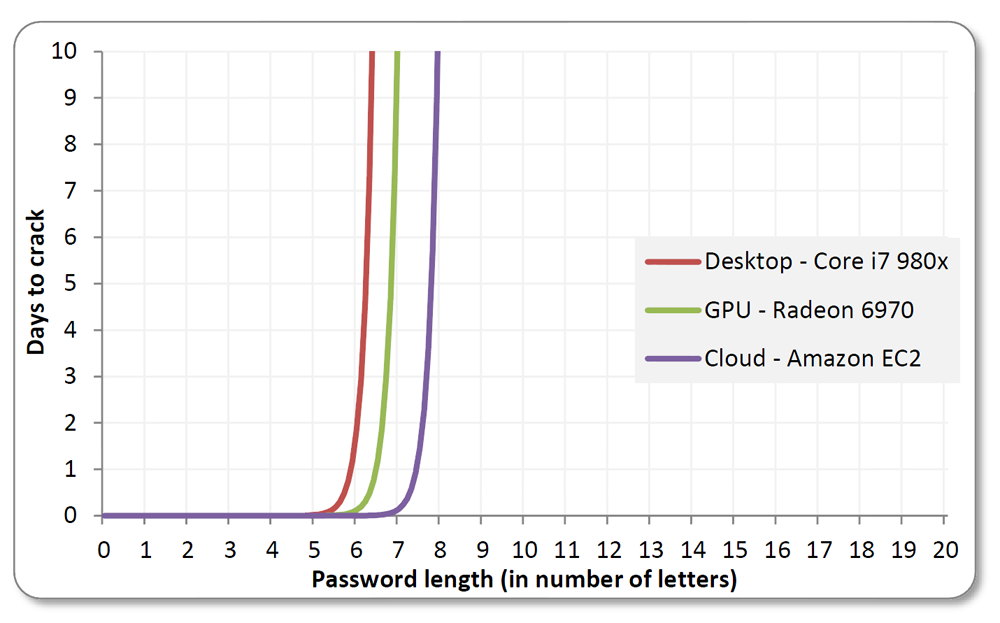
as the "exponential wall of brute-force cracking."
Enlarge/
Brute-force cracks work well against shorter passwords. The technique
can take days or months for longer passcodes, even when using Amazon's
cloud-based EC2 service.
Recognizing these limits, Gosney next brute-force cracked all
passwords of length seven or eight that contained only lower letters.
That significantly reduced the time required and still cracked 1,618
hashes. He tried all passwords of length seven or eight that contained
only upper letters to reveal another 708 plains. Because their
"keyspace" was the sum of 268 + 267, each of these
steps was completed in 41 seconds. Next, he brute-forced all passwords
made up solely of numbers from one to 12 digits long. It cracked 312
passcodes and took him three minutes and 21 seconds.
It was only then that Gosney turned to his word lists, which he has
spent years fine tuning. Augmenting the lists with the "best64" rule set
built into Hashcat, he was able to crack 6,228 hashes in just nine
minutes and four seconds. To complete stage one, he ran all the plains
he had just captured in the previous rounds through a different rule set
known as "d3ad0ne" (named after its creator who is a recognized password expert). It took one second to complete and revealed 51 more plains.
"Normally I start by brute-forcing all characters from length one to
length six because even on a single GPU, this attack completes nearly
instantly with fast hashes," Gosney explained in an e-mail. He
continued:
And because I can brute-force this really quickly, I have
all of my wordlists filtered to only include words that are at least
six chars long. This helps to save disk space and also speeds up
wordlist-based attacks. Same thing with digits. I can just brute-force
numerical passwords very quickly, so there are no digits in any of my
wordlists. Then I go straight to my wordlists + best64.rule since those
are the most probable patterns, and larger rule sets take much longer to
run. Our goal is to find the most plains in the least amount of time,
so we want to find as much low-hanging fruit as possible first.
Cracking the weakest passwords first is especially helpful when
hashes contain cryptographic salt. Originally devised to thwart rainbow
tables and other types of precomputed techniques, salting appends random
characters to each password before it is hashed. Besides defeating
rainbow tables, salting slows down brute-force and dictionary attacks
because hashes must be cracked one at a time rather than all of them at
once.
But the thing about salting is this: it slows down cracking only by a
multiple of the number of unique salts in a given list. That means the
benefit of salting diminishes with each cracked hash. By cracking the
weakest passwords as quickly as possible first (an optimization offered
by Hashcat) crackers can greatly diminish the minimal amount of
protection salting might provide against cracking. Of course, none of
this applies in this exercise since the leaked MD5 wasn't salted.
With 10,233 hashes cracked in stage one, it was time for stage two, which consisted of a series of hybrid attacks.
True to the video game analogy mentioned earlier, this second stage of
attacks took considerably longer than the first one and recovered
considerably fewer plains—to be exact, five hours and 12 minutes
produced 2,702 passwords.
As the name implies, a hybrid attack marries a dictionary attack with
a brute-force attack, a combination that greatly expands the reach of a
well-honed word list while keeping the keyspace to a manageable length.
The first round of this stage appended all possible two-characters
strings containing digits or symbols to the end of each word in his
dictionary. It recovered 585 plains and took 11 minutes and 25 seconds
to run. Round two appended all possible three-character strings
containing digits or symbols. It cracked 527 hashes and required 58
minutes to complete. The third round, which appended all four-digit
number strings, took 25 minutes and recovered 435 plains. Round four
appended all possible strings containing three lower-case letters and
digits and acquired 451 more passwords.
As fruitful as these attacks were, Gosney said they were handicapped by his use of a single graphics card for this exercise.
"For example, you'll notice that when I was doing hybrid attacks, I
appended 2-3 digits/special but then only did digits with length 4," he
explained. "This is because doing digits/special for length 4 would have
taken a really long time with just one GPU, so I skipped it. Same with
when I started appending lower alpha/digits, I only did length 3 because
length 4 would have taken too long with just one GPU."
No doubt, Gosney could have attacked much larger keyspaces had he used the monster 25-GPU cluster he unveiled in December.
Because the graphics cards in the five-server system scale almost
linearly, it's able to harness almost all of their combined power. As a
result, it can achieve 350 billion guesses per second when cracking
password hashes generated by Microsoft's NTLM algorithm. And it could
generate similar results when going up against MD5 and other fast hash
functions.
The remaining hybrid attacks in stage two continued in the same vein.
By the time it was completed, he had cracked a total of 12,935 hashes,
or 78.6 percent of the list, and had spent a total of just 5 hours and
28 minutes doing it.
One of the things Gosney and other crackers have found is that
passwords for a particular site are remarkably similar, despite being
generated by users who have never met each other. After cracking such a
large percentage of hashes from this unknown site, the next step was to
analyze the plains and mimic the patterns when attempting to guess the
remaining passwords. The result is a series of statistically generated
brute-force attacks based on a mathematical system known as Markov chains.
Hashcat makes it simple to implement this method. By looking at the
list of passwords that already have been cracked, it performs
probabilistically ordered, per-position brute-force attacks. Gosney
thinks of it as an "intelligent brute-force" that uses statistics to
drastically limit the keyspace.
Where a classic brute-force tries "aaa," "aab," "aac," and so on, a
Markov attack makes highly educated guesses. It analyzes plains to
determine where certain types of characters are likely to appear in a
password. A Markov attack with a length of seven and a threshold of 65
tries all possible seven-character passwords with the 65 most likely
characters for each position. It drops the keyspace of a classic
brute-force from 957 to 657, a benefit that saves
an attacker about four hours. And since passwords show surprising
uniformity when it comes to the types of characters used in each
position—in general, capital letters come at the beginning, lower-case
letters come in the middle, and symbols and numbers come at the
end—Markov attacks are able crack almost as many passwords as a straight
brute-force.
"This is where your attack plan deviates from the standard and
becomes unique, because now you're doing site-specific attacks," Gosney
said. "From there, if you start hitting upon any interesting patterns,
you just start chasing those patterns down the rabbit hole. Once you've
fully exploited one pattern you move on to the next."
In all, it took Gosney 14 hours and 59 minutes to complete this third
stage, which besides Markov attacks included several other custom
wordlists combined with rules. Providing further evidence of the law of
diminishing returns that dictates password cracking, it yielded 1,699
more passwords. It's interesting to note that the increasing difficulty
is experienced even within this last step itself. It took about three
hours to cover the first 962 plains in this stage and 12 hours to get
the remaining 737.
The other two password experts who cracked this list used many of the
same techniques and methods, although not in the same sequence and with
vastly different tools. The only wordlist used by radix, for example,
came directly from the 2009 breach of online games service RockYou.
Because the SQL-injection hack exposed more than 14 million unique
passwords in plaintext, the list represents the largest corpus of
real-world passwords ever to be made public. radix has a much bigger
custom-compiled dictionary, but like a magician who doesn't want to
reveal the secret behind a trick, he kept it under wraps during this
exercise.
Killing hashes
Like Nate Anderson's foray into password cracking, radix was able to
crack 4,900 of the passwords, nearly 30 percent of the haul, solely by
using the RockYou list. He then took the same list, cut the last four
characters off each of the words, and appended every possible four-digit
number to the end. Hashcat told him it would take two hours to
complete, which was longer than he wanted to spend. Even after
terminating the run two after 20 minutes, he had cracked 2,136 more
passcodes. radix then tried brute-forcing all numbers, starting with a
single digit, then two digits, then three digits, and so on (259
additional plains recovered).
He seemed to choose techniques for his additional runs almost at
random. But in reality, it was a combination of experience, intuition,
and possibly a little luck.
"It's all about analysis, gut feelings, and maybe a little magic," he
said. "Identify a pattern, run a mask, put recovered passes in a new
dict, run again with rules, identify a new pattern, etc. If you know the
source of the hashes, you scrape the company website to make a list of
words that pertain to that specific field of business and then
manipulate it until you are happy with your results."
He then ran the 7,295 plains he recovered so far through PACK, short for the Password Analysis and Cracking Toolkit
(developed by password expert Peter Kacherginsky), and noticed some
distinct patterns. A third of them contained eight characters, 19
percent contained nine characters, and 16 percent contained six
characters. PACK also reported that 69 percent of the plains were
"stringdigit" meaning a string of letters or symbols that ended with
numbers. He also noticed that 62 percent of the recovered passwords were
classified as "loweralphanum," meaning they consisted solely of
lower-case letters and numbers.
This information gave him fodder for his next series of attacks. In run 4, he ran a mask attack.
This is similar to the hybrid attack mentioned earlier, and it brings
much of the benefit of a brute-force attack while drastically reducing
the time it takes to run it. The first one tried all possible
combinations of lower-case letters and numbers, from one to six
characters long (341 more plains recovered). The next step would have
been to try all combinations of lower-case letters and numbers with a
length of eight. But that would have required more time than radix was
willing to spend. He then considered trying all passwords with a length
of eight that contained only lower-case letters. Because the attack
excludes upper case letters, the search space was manageable, 268 instead of 528.
With radix's machine, that was the difference between spending a little
more than one minute and six hours respectively. The lower threshold
was still more time than he wanted to spend, so he skipped that step
too.
So radix then shifted his strategy and used some of the rule sets
built into Hashcat. One of them allows Hashcat to try a random
combination of 5,120 rules, which can be anything from swapping each "e"
with a "3," pulling the first character off each word, or adding a
digit between each character. In just 38 seconds the technique recovered
1,940 more passwords.
"That's the thrill of it," he said. "It's kind of like hunting, but
you're not killing animals. You're killing hashes. It's like the
ultimate hide and seek." Then acknowledging the dark side of password
cracking, he added: "If you're on the slightly less moral side of it, it
has huge implications."
Steube also cracked the list of leaked hashes with aplomb. While the
total number of words in his custom dictionaries is much larger, he
prefers to work with a "dict" of just 111 million words and pull out the
additional ammunition only when a specific job calls for it. The words
are ordered from most to least commonly used. That way, a particular run
will crack the majority of the hashes early on and then slowly taper
off. "I wanted it to behave like that so I can stop when things get
slower," he explained.
Early in the process, Steube couldn't help remarking when he noticed one of the plains he had recovered was "momof3g8kids."
"This was some logic that the user had," Steube observed. "But we
didn't know about the logic. By doing hybrid attacks, I'm getting new
ideas about how people build new [password] patterns. This is why I'm
always watching outputs."
The specific type of hybrid attack that cracked that password is known as a combinator attack.
It combines each word in a dictionary with every other word in the
dictionary. Because these attacks are capable of generating a huge
number of guesses—the square of the number of words in the dict—crackers
often work with smaller word lists or simply terminate a run in
progress once things start slowing down. Other times, they combine words
from one big dictionary with words from a smaller one. Steube was able
to crack "momof3g8kids" because he had "momof3g" in his 111 million dict
and "8kids" in a smaller dict.
"The combinator attack got it! It's cool," he said. Then referring to the oft-cited xkcd comic, he added: "This is an answer to the batteryhorsestaple thing."
What was remarkable about all three cracking sessions were the types
of plains that got revealed. They included passcodes such as
"k1araj0hns0n," "Sh1a-labe0uf," "Apr!l221973," "Qbesancon321,"
"DG091101%," "@Yourmom69," "ilovetofunot," "windermere2313," "tmdmmj17,"
and "BandGeek2014." Also included in the list: "all of the lights"
(yes, spaces are allowed on many sites), "i hate hackers,"
"allineedislove," "ilovemySister31," "iloveyousomuch,"
"Philippians4:13," "Philippians4:6-7," and "qeadzcwrsfxv1331."
"gonefishing1125" was another password Steube saw appear on his computer
screen. Seconds after it was cracked, he noted, "You won't ever find it
using brute force."
The ease these three crackers had converting hashes into their
underlying plaintext contrasts sharply with the assurances many websites
issue when their password databases are breached. Last month, when
daily coupons site LivingSocial disclosed a hack that exposed names,
addresses, and password hashes for 50 million users, company executives
downplayed the risk.
"Although your LivingSocial password would be difficult to decode, we
want to take every precaution to ensure that your account is secure, so
we are expiring your old password and requesting that you create a new
one," CEO Tim O'Shaughnessy told customers.
In fact, there's almost nothing preventing crackers from deciphering
the hashes. LivingSocial used the SHA1 algorithm, which as mentioned
earlier is woefully inadequate for password hashing. He also mentioned
that the hashes had been "salted," meaning a unique set of bits had been
added to each users' plaintext password before it was hashed. It turns
out that this measure did little to mitigate the potential threat.
That's because salt is largely a protection against rainbow tables and
other types of precomputed attacks, which almost no one ever uses in
real-world cracks. The file sizes involved in rainbow attacks are so
unwieldy that they fell out of vogue once GPU-based cracking became
viable. (LivingSocial later said it's in the process of transitioning to
the much more secure bcrypt function.)
Officials with Reputation.com, a service that helps people and
companies manage negative search results, borrowed liberally from the
same script when disclosing their own password breach
a few days later. "Although it was highly unlikely that these passwords
could ever be decrypted, we immediately changed the password of every
user to prevent any possible unauthorized account access," a company
e-mail told customers.
Both companies should have said that, with the hashes exposed, users
should presume their passwords are already known to the attackers. After
all, cracks against consumer websites typically recover 60 percent to
90 percent of passcodes. Company officials also should have warned
customers who used the same password on other sites to change them
immediately.
To be fair, since both sites salted their hashes, the cracking
process would have taken longer to complete against large numbers of
hashes. But salting does nothing to slow down the cracking of a single
hash and does little to slow down attacks on small numbers of hashes.
This means that certain targeted individuals who used the hacked
sites—for example, bank executives, celebrities, or other people of
particular interest to the attackers—weren't protected at all by
salting.
The prowess of these three crackers also underscores the need for end
users to come up with better password hygiene. Many Fortune 500
companies tightly control the types of passwords employees are allowed
to use to access e-mail and company networks, and they go a long way to
dampen crackers' success.
"On the corporate side, its so different," radix said. "When I'm
doing a password audit for a firm to make sure password policies are
properly enforced, it's madness. You could go three days finding
absolutely nothing."
Websites could go a long way to protect their customers if they
enforced similar policies. In the coming days, Ars will publish a
detailed primer on passwords managers. It will show how to use them to
generate long, random passcodes that are unique to each site. Because
these types of passwords can only be cracked by brute force, they are
the hardest to recover. In the meantime, readers should take pains to
make sure their passwords are a minimum of 11 characters, contain upper-
and lower-case letters, numbers, and letters, and aren't part of a
pattern.
The ease these crackers had in recovering as many as 90 percent of
the hashes they targeted from a real-world breach also exposes the
inability many services experience when trying to measure the relative
strength or weakness of various passwords. A recently launched site from
chipmaker Intel asks users "How strong is your password?," and it
estimated it would take six years to crack the passcode "BandGeek2014". That estimate is laughable given that it was one of the first ones to fall at the hands of all three real-world crackers.
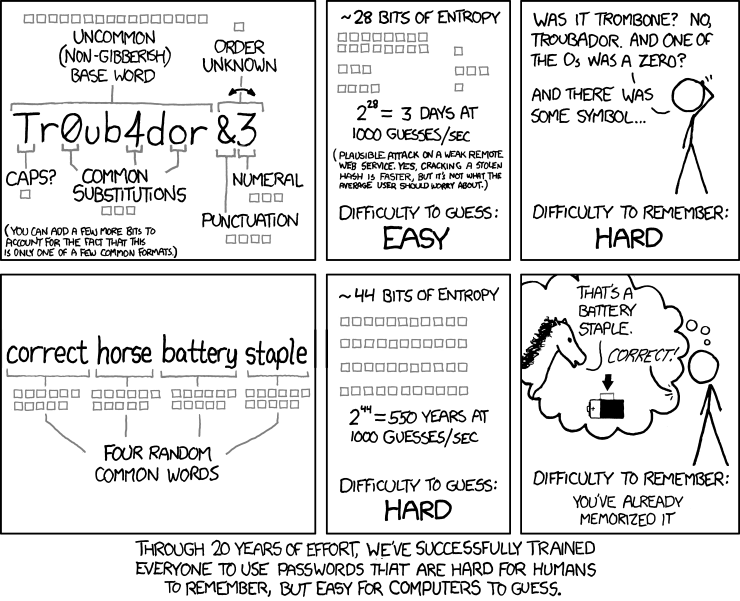
As Ars explained recently,
the problem with password strength meters found on many websites is
they use the total number of combinations required in a brute-force
crack to gauge a password's strength. What the meters fail to account
for is that the patterns people employ to make their passwords memorable
frequently lead to passcodes that are highly susceptible to much more
efficient types of attacks.
"You can see here that we have cracked 82 percent [of the passwords]
in one hour," Steube said. "That means we have 13,000 humans who did not
choose a good password." When academics and some websites gauge
susceptibility to cracking, "they always assume the best possible
passwords, when it's exactly the opposite. They choose the worst."
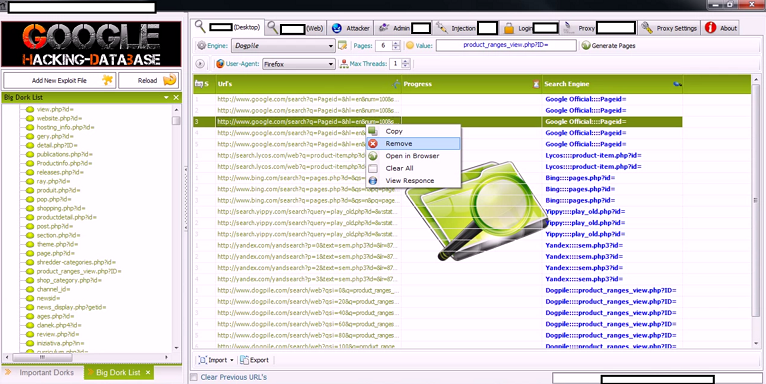
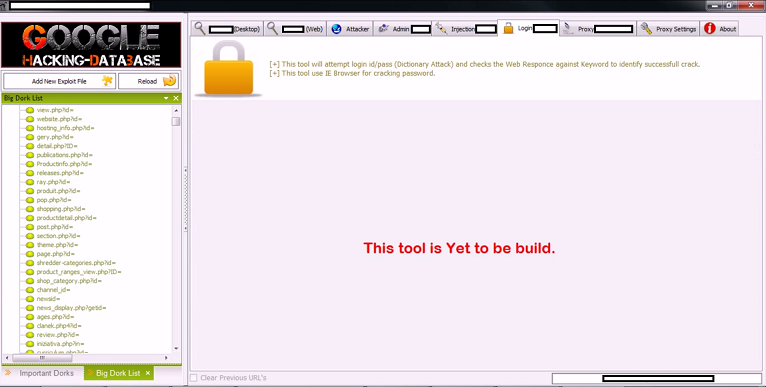
A new version of DIY Google Dorks based hacking tool has been
released, it is an extremely useful tool for reconnaissance of targets.
A Webroot blog post
announced that a new version of DIY Google Dorks based hacking tool has
been released in the wild and it could be used for mass website
analysis, the power of the popular search engine could be exploited for
information gathering during the reconnaissance phase of an attack.
Similar tools could be used to acquire information on target
environments by an attacker or by the pen tester to evaluate the
architecture is starting to test. The availability of the DIY Google
Dorks based hacking tool allows to ill-intentioned to acquire precious
information on remotely exploitable websites, data that could be
collected to compromise them for example deploying a malicious exploit kit or exploiting known vulnerabilities. The tool relies on Google Dorks the
tools to allow a target evaluation, in particular the DIY Google Dorks
based hacking tool has built-in features that can be used to evaluate
the possibility to perform a SQL injection attack or to discover all the targets that aren’t protected by a CAPTCHA
challenge mechanism. As usual the project appears under continuous
development and the authors are still working on it to improve its
capabilities with new features such as the possibility to evaluate the
vulnerability to a custom malicious exploits. Composing specifically
crafted queries in Google it is possible to reveal sensitive information
essential for the success of an attack, thanks to the use of the
advanced operator, the dorking, is possible to retrieve a huge quantity of information on a target such as:
User’s credentials.
Sensitive documents.
Admin login page.
Email lists.
The syntax for using advanced operator in Google is
Operator_name:keyword
Following some sample of keyword/advance operator:
Allintext
Searches for occurrences of all the keywords given
Intext
Searches for the occurrences of keywords all at once or one at a time
Inurl
Searches for a URL matching one of the keywords
Allinurl
Searches for a URL matching all the keywords in the query
Intitle
Searches for occurrences of keywords in URL all or one
Allintitle
Searches for occurrences of keywords all at a time
Site
Specifically searches that particular site and lists all the results for that site
filetype
Searches for a particular filetype mentioned in the query
Link
Searches for external links to pages
Numrange
Used to locate specific numbers in your searches
Daterange
Used to search within a particular date range
Using more complex queries an attacker could obtain a series of
information on the status of the target, for example to discover if it
has been already “backdoored” and discovery which are the vulnerability that can potentially affect the system. The Google hacking database
provides various examples of queries that can help a hacker to find
vulnerable servers, to gain information on the target, to explore
sensitive directories finding vulnerable files, to find password files
or to find sensitive online shopping info.
inurl:”r00t.php” – This dork finds websites that were hacked, backdoored and contains their system information allintext:”fs-admin.php“ – A foothold using allintext:”fs-admin.php”
shows the world readable directories of a plug-in that enables
WordPress to be used as a forum. Many of the results of the search also
show error logs which give an attacker the server side paths including
the home directory name. This name is often also used for the login to ftp and shell access, which exposes the system to attack. There is also an undisclosed flaw in version 1.3 of the software, as the author has mentioned in version 1.4 as a security fix, but does not tell us what it is that was patched.filetype:config inurl:web.config inurl:ftp – This google dork to find sensitive information ofMySqlServer , “uid, and password” in web.config through ftp..filetype:config inurl:web.config inurl:ftp
The above dorks are just simple examples of the power of these search
strings, just after 10 minutes playing with them user has the
perception of the infinite possibilities that Google provides to an
attacker. Now imagine a single DIY Google Dorks based hacking tool that
allows to automatize all this queries, without having particular
knowledge on Google dorks …
it’s the hacker heaven, what do you think about? The DIY Google Dorks
based hacking tool proposed by Dancho Danchev offers a complete suite to
automate the process of remote inspection of targets and their exploit,
the instrument works on desktop and could be also integrated with
popular browsers to fool the search engines into thinking that generated
traffic is legitimate traffic.
The price for the DIY Google Dorks based hacking tool is very cheap
compared to the advantage deriving from its use, one license costs $10
to pay using the Liberty Reserve currency, or $11 to pay using Western
Union transfer. The license are linked to specific host due a hardware-based ID restriction, but the authors also offers an unlimited license for $20 in Liberty Reserve, or $20 in Western Union transfer.
Cyber criminals can exploit hundreds of thousands of legitimate Web
sites is various ways and tools such as the DIY Google Dorks based
hacking tool facilitate attacks. Dancho Danchev in his interesting post described the principal techniques used to compromise website:
Use of search engine reconnaissance through DIY SQL/RFI (Remote File Inclusion) tools or botnets, the category includes a wide range of application that automatically exploit improper configured websites such as blogging platforms or well known CMS.
Use of data mined or purchased stolen accounting data, cyber
criminals could gather information on malware infected machine, looking
for login credentials to be automatically abused with malicious scripts
and actual executables getting hosted on legitimate websites in an attempt to trick a security solution’s IP reputation process.
Active exploitation of server farms – criminals try to infect the
larger number of low profile websites as possible, a common practice
observed by security researchers is the exploiting of servers that host
large number of domains, for example using commercially availableApache backdoors.
Cybercrime
underground is in offering all necessary to organize a fraud without
having particular knowledge of various technological platforms (e.g.
Mobile) and proposing a new efficient model of sales such as the FaaS… it is crucial to follow the black market evolution to avoid shocking surprises.

 While the National Security Agency (NSA) makes nearly-daily headlines
about spying on people and their Internet activity, a new application
recently released to the public can reportedly crack passwords with 8
million guesses per second.
While the National Security Agency (NSA) makes nearly-daily headlines
about spying on people and their Internet activity, a new application
recently released to the public can reportedly crack passwords with 8
million guesses per second. In March, readers followed along as




 Posts
Posts