Showing posts with label Cybercrime underground. Show all posts

Friday, 30 August 2013

Data breach interactive chart shows major increase in security flaws


Data breach interactive chart shows major increase in security flaws
If you didn’t believe us that hackers have been keeping themselves really busy in the last few years, this interactive graphic might just be the visual proof you need.
David McCandless of Information is Beautiful created the graphic with coder Tom Evans. It shows all the different “data breaches” that have occurred since 2004 affecting more than 30,000 people. Each attack is displayed as a bubble, based on that victim-count. You can also filter by year, method of leak, what was stolen, and the type of organization.
Pretty much any article about a hack you might read includes some mention of how “cyberattacks are growing,” and “the amount of hacks have increased in the last X amount of years.” This graphic gives those call-outs merit, but also highlights some of the internal mistakes companies have made that let regular folks accidentally leak out data .
As you scroll up from 2004, the size of the breaches actually seem to diminish slightly, but the frequency definitely increases and varies from hundreds of thousands to tens of millions of victims. You can click on each bubble to get a little more information about the breach and click through to a report.
Check it out and let us know what you think of the interactive graphic.

Monday, 26 August 2013

India: Talent hotspot for global cybercrime industry

MUMBAI: India is fast emerging as a talent hotspot for the global cybercrime industry amid slow hiring in the traditional software industry, the lure of easy money, and lack of law enforcement, according to computer security experts.Millions of Americans  are locked out of online access to their bank accounts. (Source: US ABC)
Work such as hacking into computer networks and creation of malware is being outsourced to cyber-mercenaries in India through underground marketplaces. It is possible to rent botnets - computers controlled by a hacker - to launch disabling attacks to bring down websites for as little as $2 ( Rs 125) per hour.

"Increasingly, India is becoming not just the victim but the host country with regard to cyber attacks," Jagdish Mahapatra, managing director for India and SAARC at anti-virus maker McAfee, told ET. The process has become so organised that some of these hacking services come with Live Chat customer support, according to McAfee.

In 2012, McAfee Labs identified at least 850 separate bits of ready-to-download malware hosted on computers in India. In the first quarter of 2013, the number had jumped to 1,100. India is ranked eighth in the world in terms of number of attacks originating here, a report by Akamai Technologies in May said.

"Blackhats can make a lot of money, so I'm not surprised that we're beginning to see cybercrime markets emerge in India," said Oxblood Ruffin, a Canadian hacktivist based in Bangalore. In Internet security language, a blackhat refers to someone who exploits vulnerabilities in computers with malicious intent or personal gain. In March, Norwegian telecommunications services provider Telenor reported an intrusion into its computer networks. Cybersecurity company Norman Shark traced that attack to India and documented it in a whitepaper titled 'Unveiling an Indian Cyber-attack Infrastructure'.

India has the 'skills'
"You have underground hacker forums where people post their hacking requirement and you can bid for them and have the money transferred to a PayPal account via a service called Perfect Money," Sarvaiya said. While ethical hackers could earn 30,000 a mon-th legally, cybercrime fetches more than $2,000 (Rs 1,30,000) a month.

Perfect Money functions as an e-currency. The currency units can be transferred between customers, whose identities can be hidden. The units can be redeemed for cash - in dollars or euros - or gold by third-party exchange services.

The hacker forums cannot be accessed via standard web browsers - what is required is a special browser called a Tor Browser that allows access to the 'hidden web' where these blackhat hackers operate.

The forums look like a social networking site designed by death-metal fans. Attempts by ET to contact hackers on these forums were not successful.

Some of the traits that made India the hub for sourcing technology services are also contributing to the rise of this new dubious trade. "You need software skills; the country has that capability. Then you need motivation, which is the money, and the knowledge that the Indian legal system is likely to not be able to prosecute you. These are cross-border computer crimes, our laws have not reached that point," said Dinesh Pillai, CEO of Mahindra Special Services Group.

There is no estimate of the number of Indian hackers for hire. And security industry professionals said while they knew the number of attacks from India was rising, they could not pinpoint individual attacks that could be attributed to Indian hackers.

"It used to be the eastern European countries that had the skilled manpower to provide hackers for hire, but now we can see that moving to emerging economies like India and Sri Lanka where job opportunities have shrunk," said Diwakar Dayal, who leads security sales for Cisco in South Asia.

Hackers are also emboldened by the belief that they are unlikely to get into trouble with the law. While there are sections in the IT Act that govern hacking, cross-border crimes are hard to police even in the real world.

"We have the requisite laws to try and punish such cross-border cybercrimes, even if they are committed by foreign nationals. But it becomes practically difficult due to the need for information sharing and reciprocity (in case of extradition) between countries," said Dipak Parmar, founder of Cyber-IPR.

Experts said a number of steps need to be taken if the rise in this type of crime has to be stemmed.

"The government's cybersecurity policy is a step in the right direction, but internet service providers also play a role. Network security across the board has to be strengthened in the country," Cisco's Dayal said.

Sunday, 25 August 2013

U.S. spied on United Nations by hacking into video conferencing system at New York headquarters: report

The German magazine Der Spiegel says the U.S. National Security Agency secretly monitored the U.N.’s internal video conferencing system by decrypting it last year.
Susan Rice, U.S. Ambassador to the UN, is seen on the television screens during a UN General Assembly vote at the New York headquarters. The National Security Agency broke the encryption securing the United Nations' internal video conferencing at its headquarters, German news weekly Der Spiegel reported on August 25, 2013, citing secret NSA documents.

The weekly said Sunday that documents it obtained from American leaker Edward Snowden show the NSA decoded the system at the UN’s headquarters in New York last summer.
Quoting leaked NSA documents, the article said the decryption “dramatically increased the data from video phone conferences and the ability to decode the data traffic.”
AP Photo/The Guardian, File
AP Photo/The Guardian, FileEdward Snowden, who worked as a contract employee at the U.S. National Security Agency, in Hong Kong.
In three weeks, Der Spiegel said, the NSA increased the number of decrypted communications at the UN from 12 to 458.
Snowden’s leaks have exposed details of the United States’ global surveillance apparatus, sparking an international debate over the limits of American spying.
The U.S. government’s efforts to determine which highly classified materials the leaker took from the National Security Agency have been frustrated by Snowden’s sophisticated efforts to cover his digital trail by deleting or bypassing electronic logs, government officials told The Associated Press. Such logs would have showed what information Snowden viewed or downloaded.
The government’s forensic investigation is wrestling with Snowden’s apparent ability to defeat safeguards established to monitor and deter people looking at information without proper permission, said the officials, who spoke on condition of anonymity because they weren’t authorized to discuss the sensitive developments publicly.
The disclosure undermines the Obama administration’s assurances to Congress and the public that the NSA surveillance programs can’t be abused because its spying systems are so aggressively monitored and audited for oversight purposes: If Snowden could defeat the NSA’s own tripwires and internal burglar alarms, how many other employees or contractors could do the same?
In July, nearly two months after Snowden’s earliest disclosures, NSA Director Keith Alexander declined to say whether he had a good idea of what Snowden had downloaded or how many NSA files Snowden had taken with him, noting an ongoing criminal investigation.
SAUL LOEB/AFP/Getty Images
SAUL LOEB/AFP/Getty ImagesThe National Security Agency (NSA) headquarters at Fort Meade, Maryland, as seen from the air, in this January 29, 2010 file photo. The NSA has said that it destroys all data it isn't supposed to see.
NSA spokeswoman Vanee Vines told the AP that Alexander “had a sense of what documents and information had been taken,” but “he did not say the comprehensive investigation had been completed.” Vines would not say whether Snowden had found a way to view and download the documents he took without the NSA knowing.
In defending the NSA surveillance programs that Snowden revealed, Deputy Attorney General James Cole told Congress last month that the administration effectively monitors the activities of employees using them.
These decisions are made to make sure that nobody has done the things that you’re concerned about happening
“This program goes under careful audit,” Cole said. “Everything that is done under it is documented and reviewed before the decision is made and reviewed again after these decisions are made to make sure that nobody has done the things that you’re concerned about happening.”
The disclosure of Snowden’s hacking prowess inside the NSA also could dramatically increase the perceived value of his knowledge to foreign governments, which would presumably be eager to learn any counter-detection techniques that could be exploited against U.S. government networks.
It also helps explain the recent seizure in Britain of digital files belonging to David Miranda – the partner of Guardian journalist Glenn Greenwald – in an effort to help quantify Snowden’s leak of classified material to the Guardian newspaper. Authorities there stopped Miranda last weekend as he changed planes at Heathrow Airport while returning home to Brazil from Germany, where Miranda had met with Laura Poitras, a U.S. filmmaker who has worked with Greenwald on the NSA story.
Marcelo Piu/AFP/Getty Images
Marcelo Piu/AFP/Getty ImagesDavid Miranda (left), the Brazilian partner of Glenn Greenwald, a U.S. journalist with Britain's Guardian newspaper who worked with intelligence leaker Edward Snowden to expose US mass surveillance programmes, is pictured at Rio de Janeiro's Tom Jobim international airport upon his arrival on August 19, 2013. British authorities faced a furore after they held Miranda for almost nine hours under anti-terror laws as he passed through London's Heathrow Airport on his way home to Rio de Janeiro from Berlin.
Snowden, a former U.S. intelligence contractor, was employed by Booz Allen Hamilton in Hawaii before leaking classified documents to the Guardian and The Washington Post. As a system administrator, Snowden had the ability to move around data and had access to thumb drives that would have allowed him to transfer information to computers outside the NSA’s secure system, Alexander has said.
In his job, Snowden purloined many files, including ones that detailed the U.S. government’s programs to collect the metadata of phone calls of U.S. citizens and copy Internet traffic as it enters and leaves the U.S., then routes it to the NSA for analysis.
Officials have said Snowden had access to many documents but didn’t know necessarily how the programs functioned. He dipped into compartmentalized files as systems administrator and took what he wanted. He managed to do so for months without getting caught. In May, he flew to Hong Kong and eventually made his way to Russia, where that government has granted him asylum.
NBC News reported Thursday that the NSA was “overwhelmed” in trying to figure what Snowden had stolen and didn’t know everything he had downloaded.
Insider threats have troubled the administration and Congress, particularly in the wake of Bradley Manning, a young soldier who decided to leak hundreds of thousands of sensitive documents in late 2009 and early 2010.
Congress had wanted to address the insider threat problem in the 2010 Intelligence Authorization Act, but the White House asked for the language to be removed because of concerns about successfully meeting a deadline. In the 2013 version, Congress included language urging the creation of an automated, insider-threat detection program.

Thursday, 11 July 2013

Citadel: a cyber-criminal’s ultimate weapon?

In old times, a citadel was a fortress used as the last line of defense. For cyber criminals it is a powerful and state-of-the-art toolkit to both distribute malware and manage infected computers (bots). Citadel is an offspring of the (too) popular Zeus crimekit whose main goal is to steal banking credentials by capturing keystrokes and taking screenshots/videos of victims’ computers. Citadel came out circa January 2012 in the online forums and quickly became a popular choice for criminals. A version of Citadel (1.3.4.5) was leaked in late October and although it is not the latest (1.3.5.1), it gives us a good insight into what tools the bad guys are using to make money.
In this post, I will show you how criminals operate a botnet. This is not meant as a tutorial and I do want to stress that running a botnet is illegal and could send you to jail.

A nice home
In order to get into business the bad guys need a server that is hosted at a company that will turn a blind eye on their activities and also guarantee them some anonymity. Such companies are called Bulletproof hosting and can be found in most underground forums (Figure 1).
Figure 1: an ad for Bulletproof hosting
Those hosting firms are for the most part located in countries like China or Russia and therefore in their own jurisdiction where so long as you don’t commit crimes against your own people not a whole lot can happen to you. To cover their tracks even more, the bad guys use proxy or VPN services that disguise their own IP address.
A shiny new toy
Once set up with a server, it is time to install what will be the mastermind program to create and organize an entire array (botnet) of infected computers worldwide. A variety of crimekits exist but in this post we will concentrate on Citadel.
Once again, the core installation files can be found in the underground community or through your own connections. Recently, the Citadel kit was withdrawn from forums to prevent too much exposure and attention. It costs around $3000 USD.
Figure 2 shows what the package looks like. An instruction manual in both Russian and English is provided. The kit requires server software such as Apache, and PHP with a MySQL database to work properly.
Figure 2: the citadel package
 To install Citadel, you simply browse to the install folder with your browser (Figure 3) and set up the main access username and password as well as database information.
Figure 3: Citadel’s installation screen
In this testing, the installer did not automatically create the database but you can do so by hand (Figure 4):
Figure 4: creating a database for Citadel’s exploit pack
To finally access the login page, you need to browse to the cp.php file (Figure 5):
Figure 5: Citadel’s login page
 Before logging in, I want to show you the other component that makes this package complete. It is called the builder (Figure 6) and is essentially used to create the piece of malware that criminals will distribute (forced installs through infected websites) and that links to their crimekit.
Figure 6: creating the Citadel bot with the builder
 The malware is built to avoid AV detection and is tested with online virus scanners like Scan4You, an equivalent to the popular VirusTotal except this one is totally anonymous and does not share uploaded samples with antivirus vendors. Speaking of which, once installed on the victim’s machine, the malware will prevent access to security sites (Figure 7).
Figure 7: a list of antivirus vendors that are blocked by Citadel’s malware
Here is an example of an infection from a Citadel Trojan.
Infected PCs all report to the mothership and wait for orders. This is where it gets interesting because making malware is one thing but actually managing your own campaigns is the key to success. The Citadel control panel is well designed and puts a lot of features at your fingertips (Figure 8).

Figure 8: Citadel’s Control Panel
Each feature is actually a module written in PHP as seen on Figure 9. The control panel gives you an overview of the machines that have been infected. It’s a sort of Malware Analytics with stats by country, Operating System, etc…
Figure 9: Citadel’s modules
 The main purpose of Citadel is to steal banking credentials and so it’s no big surprise to see advanced search features to specifically look for financial institutions (Figure 10).
Figure 10: Citadel’s advanced search features
A password is a password whether it’d be for a bank or something more common like a Facebook or Gmail account. In fact, you can customize any site that is of interest to you and capture the credentials.  Notifications of successfully stolen passwords can be sent via Instant Message through the Jabber protocol (Figure 11).
Figure 11: Citadel’s custom rules and notifications
Stolen credentials are harvested by various means:
  • Keystroke logging
  • Screenshot capture
  • Video capture
A powerful feature used to trick users into revealing confidential information is dubbed WebInject. It is powerful because it happens in real time and is completely seamless. A WebInject is a piece of code that contains HTML and JavaScript which creates a fake pop-up that asks the victim for personal information within the context of logging into a site. The bad guys can trigger it in two ways: either automatically when a site of interest is opened by the victim, or manually on the fly.
It is the ultimate phishing tool because it does not go against any known proper precautions a user would normally take. For instance, the site’s URL is unchanged and shows the secure pad lock with the financial institution’s SSL certificate (Figure 12). This type of hack is also called a man-in-the-middle attack.

Figure 12: Man-in-the-middle attack through webinject
In case this method does not work (some people might get suspicious), the bad guys can always revert to a more direct approach with some ransomware. Citadel is also involved in the distribution of the FBI Moneypak (also known as Reveton) malware which locks the user out of his computer and demands $200 (Figure 13). It is customized based on the victim’s country of origin.

Figure 13: Reveton ransomware distributed by Citadel Trojan
Since a lot of people download music and movies from torrents or other shady sites, the message tricks them into thinking they have been caught by the local authorities. It’s a very smart scare tactic which works quite well, unfortunately. To add to the drama, the malware will attempt to turn on the user’s webcam as if they were already under surveillance.
The FBI has posted an article regarding this scam (http://www.fbi.gov/news/stories/2012/august/new-internet-scam) and urges people to not pay any money as it could get you into even more troubles.
Malwarebytes users are protected against the FBI Moneypak malware. If you aren’t one of them and are already infected you can remove this ransomware by following these 3 steps:
  1. Reboot your computer into Safe Mode with Networking. (Instructions from Microsoft here)
  2. Download Malwarebytes Anti-Malware.
  3. Run Malwarebytes Anti-Malware and remove all malware (Figure 14)
That’s it!

Figure 14: Reveton ransomware Trojan detected by Malwarebytes Anti-Malware.
What’s next for Citadel?
The latest version (1.3.5.1) whose code name is Rain Edition is getting pricey at $3931 but it includes a lot of valuable features (advanced support for Chrome and Firefox, improved WebInjects, smarter ‘on-the-fly’ updates to the Trojan, etc…).
The makers of Citadel are trying to keep a low enough profile to avoid gathering too much attention which could result in efforts to go after them (as we have seen with Zeus). Getting your hands on Citadel is more difficult because of a stricter validation process within the Russian underground.
How to protect yourself
When seeing such technically advanced crimekits it puts a lot of things into perspective. The methods used to steal personal information are so advanced and sneaky that even the most cautious user may get fooled. It is best to avoid infection in the first place by using a solution such as Malwarebytes Anti-Malware PRO that constantly protects your computer by blocking malicious sites and files. Using a combination of both safe online practices (if you ever feel uncomfortable disclosing personal information, give your bank a call or ask a friend) and a good anti malware solution will keep you safe(r).

Friday, 10 May 2013

Hacking with new DIY Google Dorks based hacking tool

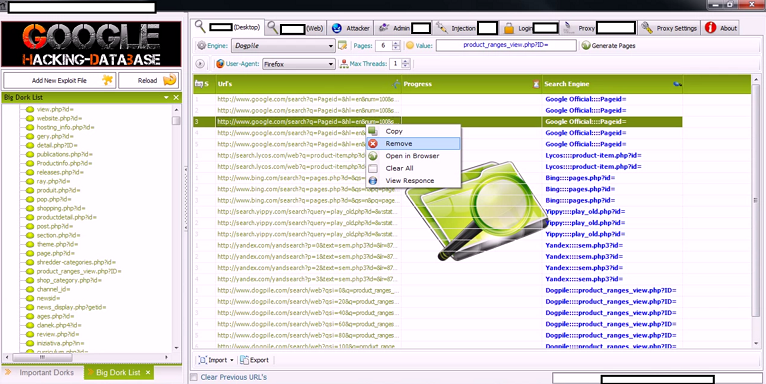
A new version of DIY Google Dorks based hacking tool has been released, it is an extremely useful tool for reconnaissance of targets.

A Webroot blog post announced that a new version of DIY Google Dorks based hacking tool has been released in the wild and it could be used for mass website analysis, the power of the popular search engine could be exploited for information gathering during the reconnaissance phase of an attack. Similar tools could be used to acquire information on target environments by an attacker or by the pen tester to evaluate the architecture is starting to test. The availability of the DIY Google Dorks based hacking tool allows to ill-intentioned to acquire precious information on remotely exploitable websites, data that could be collected to compromise them for example deploying a malicious exploit kit or exploiting known vulnerabilities. The tool relies on Google Dorks the tools to allow a target evaluation, in particular the DIY Google Dorks based hacking tool has built-in features that can be used to evaluate the possibility to perform a SQL injection attack or to discover all the targets that aren’t protected by a CAPTCHA challenge mechanism. As usual the project appears under continuous development and the authors are still working on it to improve its capabilities with new features such as the possibility to evaluate the vulnerability to a custom malicious exploits. Composing specifically crafted queries in Google it is possible to reveal sensitive information essential for the success of an attack, thanks to the use of the advanced operator, the dorking, is possible to retrieve a huge quantity of information on a target such as:
  • User’s credentials.
  • Sensitive documents.
  • Admin login page.
  • Email lists.
The syntax for using advanced operator in Google is
Operator_name:keyword
Following some sample of keyword/advance operator:
Allintext Searches for occurrences of all the keywords given
Intext Searches for the occurrences of keywords all at once or one at a time
Inurl Searches for a URL matching one of the keywords
Allinurl Searches for a URL matching all the keywords in the query
Intitle Searches for occurrences of keywords in URL all or one
Allintitle Searches for occurrences of keywords all at a time
Site Specifically searches that particular site and lists all the results for that site
filetype Searches for a particular filetype mentioned in the query
Link Searches for external links to pages
Numrange Used to locate specific numbers in your searches
Daterange Used to search within a particular date range
Using more complex queries an attacker could obtain a series of information on the status of the target, for example to discover if it has been already “backdoored” and discovery which are the vulnerability that can potentially affect the system. The Google hacking database provides various examples of queries that can help a hacker to find vulnerable servers, to gain information on the target, to explore sensitive directories finding vulnerable files, to find password files or to find sensitive online shopping info.
inurl:”r00t.php”  – This dork finds websites that were hacked, backdoored and contains their system information allintext:”fs-admin.php“ – A foothold using allintext:”fs-admin.php” shows the world readable directories of a plug-in that enables WordPress to be used as a forum. Many of the results of the search also show error logs which give an attacker the server side paths including the home directory name. This name is often also used for the login to ftp and shell access, which exposes the system to attack. There is also an undisclosed flaw in version 1.3 of the software, as the author has mentioned in version 1.4 as a security fix, but does not tell us what it is that was patched. filetype:config inurl:web.config inurl:ftp – This google dork to find sensitive information of MySqlServer , “uid, and password” in web.config through ftp..filetype:config inurl:web.config inurl:ftp
The above dorks are just simple examples of the power of these search strings, just after 10 minutes playing with them user has the perception of the infinite possibilities that Google provides to an attacker. Now imagine a single DIY Google Dorks based hacking tool  that allows to automatize all this queries, without having particular knowledge on Google dorks … it’s the hacker heaven, what do you think about? The DIY Google Dorks based hacking tool proposed by Dancho Danchev offers a complete suite to automate the process of remote inspection of targets and their exploit, the instrument works on desktop and could be  also integrated with popular browsers to fool the search engines into thinking that generated traffic is legitimate traffic.
DIY Google Dorks based hacking tool 1
  The price for the DIY Google Dorks based hacking tool is very cheap compared to the advantage deriving from its use, one license costs $10 to pay using the Liberty Reserve currency, or $11 to pay using Western Union transfer. The license are linked to specific host due a hardware-based ID restriction, but the authors also offers an unlimited license for $20 in Liberty Reserve, or $20 in Western Union transfer.
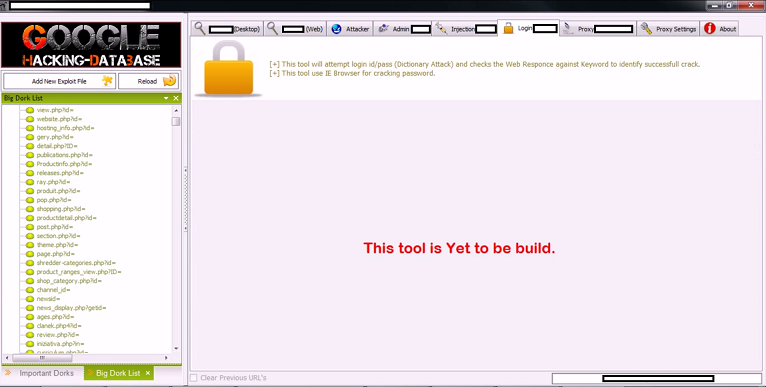
DIY Google Dorks based hacking tool 2
 DIY Google Dorks based hacking tool 3
Cyber criminals can exploit hundreds of thousands of legitimate Web sites is various ways and tools such as the DIY Google Dorks based hacking tool facilitate attacks. Dancho Danchev in his interesting post described the principal techniques used to compromise website:
  • Use of search engine reconnaissance through DIY SQL/RFI (Remote File Inclusion) tools or botnets, the category includes a wide range of application that automatically exploit improper configured websites such as  blogging platforms or well known CMS.
  • Use of data mined or purchased stolen accounting data, cyber criminals could gather information on malware infected machine, looking for login credentials to be automatically abused with malicious scripts and actual executables getting hosted on legitimate websites in an attempt to trick a security solution’s IP reputation process.
  • Active exploitation of server farms – criminals try to infect the larger number of low profile websites as possible, a common practice observed by security researchers is the exploiting of servers that host large number of domains, for example using commercially available Apache backdoors.
Cybercrime underground is in offering all necessary to organize a fraud without having particular knowledge of various technological platforms (e.g. Mobile) and proposing a new efficient model of sales such as the FaaS… it is crucial to follow the black market evolution to avoid shocking surprises.