Thursday, 17 December 2015

Quick Android Review Kit

QARK

Quick Android Review Kit - This tool is designed to look for several security related Android application vulnerabilities, either in source code or packaged APKs. The tool is also capable of creating "Proof-of-Concept" deployable APKs and/or ADB commands, capable of exploiting many of the vulnerabilities it finds. There is no need to root the test device, as this tool focuses on vulnerabilities that can be exploited under otherwise secure conditions.

Usage

To run in interactive mode:
$ python qark.py
To run in headless mode:
$ python qark.py --source 1 --pathtoapk /Users/foo/qark/sampleApps/goatdroid/goatdroid.apk --exploit 1 --install 1
or
$ python qark.py --source 2 -c /Users/foo/qark/sampleApps/goatdroid/goatdroid --manifest /Users/foo/qark/sampleApps/goatdroid/goatdroid/AndroidManifest.xml --exploit 1 --install 1
The sampleApps folder contains sample APKs that you can test against QARK

Requirements

  • python 2.7.6
  • JRE 1.6+ (preferably 1.7+)
  • OSX or Ubuntu Linux (Others may work, but not fully tested)

Documentation

QARK is an easy to use tool capable of finding common security vulnerabilities in Android applications. Unlike commercial products, it is 100% free to use. QARK features educational information allowing security reviewers to locate precise, in-depth explanations of the vulnerabilities. QARK automates the use of multiple decompilers, leveraging their combined outputs, to produce superior results, when decompiling APKs. Finally, the major advantage QARK has over traditional tools, that just point you to possible vulnerabilities, is that it can produce ADB commands, or even fully functional APKs, that turn hypothetical vulnerabilities into working "POC" exploits.
Included in the types of security vulnerabilities this tool attempts to find are:
  • Inadvertently exported components
  • Improperly protected exported components
  • Intents which are vulnerable to interception or eavesdropping
  • Improper x.509 certificate validation
  • Creation of world-readable or world-writeable files
  • Activities which may leak data
  • The use of Sticky Intents
  • Insecurely created Pending Intents
  • Sending of insecure Broadcast Intents
  • Private keys embedded in the source
  • Weak or improper cryptography use
  • Potentially exploitable WebView configurations
  • Exported Preference Activities
  • Tapjacking
  • Apps which enable backups
  • Apps which are debuggable
  • Apps supporting outdated API versions, with known vulnerabilities

Roadmap

Things that are coming soon:
  • Rewrite of code to support extensibility
  • Bound Service vulnerability detection and exploitation
  • Content Provider vulnerability detection and exploitation
  • Additional WebView configuration demonstrations
  • Static Tapjacking mitigation detection
  • File browser capable of using root permissions

Notice

Note: QARK decompiles Android applications back to raw source code. Please do not use this tool if this may be considered illegal in your juristdiction. If you are unsure, seek legal counsel.
If you run into issues on OSX, especially relating to the outbound call to the Play Store, or the downloading of the SDK, it is likely due to your Python/OpenSSL configuration and the fact that recent changes in OSX impacted Python installed via brew. Nuking your Python installation(s) and re-installing from source may fix your issues.

Refer url : https://github.com/linkedin/qark

Wednesday, 9 December 2015

HASHCAT

Hashcat is an advanced CPU-based password recovery utility for Windows 7/8/10, Apple OS X, and GNU/Linux, supporting seven unique modes of attack for over 100 optimized hashing algorithms.


Hashcat Screenshot


Features 

  • Multi-Threaded
  • Free
  • Open-Source
  • Multi-Hash (up to 24 million hashes)
  • Multi-OS (Linux, Windows and OSX native binaries)
  • Multi-Algo (MD4, MD5, SHA1, DCC, NTLM, MySQL, ...)
  • SSE2, AVX and XOP accelerated
  • All Attack-Modes except Brute-Force and Permutation can be extended by rules
  • Very fast Rule-engine
  • Rules compatible with JTR and PasswordsPro
  • Possible to resume or limit session
  • Automatically recognizes recovered hashes from outfile at startup
  • Can automatically generate random rules
  • Load saltlist from external file and then use them in a Brute-Force Attack variant
  • Able to work in an distributed environment
  • Specify multiple wordlists or multiple directories of wordlists
  • Number of threads can be configured
  • Threads run on lowest priority
  • Supports hex-charset
  • Supports hex-salt

Contributing


Contributions are welcome and encouraged, provided your code is of sufficient quality. Before submitting a pull request, please ensure your code adheres to the following requirements:
  1. Licensed under MIT license, or dedicated to public domain (BSD, GPL, etc. code is incompatible)
  2. Adheres to either C89, C90, or C99 standards
  3. Compiles cleanly with no warnings when compiled with -W -Wall -std=c99
  4. Uses Allman-style code blocks & indentation
  5. Uses 2-spaces as indentation or a tab if it's required (for example: Makefiles)
  6. Uses lower-case function and variable names
  7. Avoids the use of ! and uses positive conditionals wherever possible (e.g., if (foo == 0) instead of if (!foo), and if (foo) instead of if (foo !=0))
  8. Use code like array[index + 0] if you also need to do array[index + 1], to keep it aligned
You can use GNU Indent to help assist you with the style requirements:
indent -st -bad -bap -sc -bl -bli0 -ncdw -nce -cli0 -cbi0 -pcs -cs -npsl -bs -nbc -bls -blf -lp -i2 -ts2 -nut -l1024 -nbbo -fca -lc1024 -fc1
Your pull request should fully describe the functionality you are adding/removing or the problem you are solving. Regardless of whether your patch modifies one line or one thousand lines, you must describe what has prompted and/or motivated the change.
Solve only one problem in each pull request. If you're fixing a bug and adding a new feature, you need to make two separate pull requests. If you're fixing three bugs, you need to make three separate pull requests. If you're adding four new features, you need to make four separate pull requests. So on, and so forth.
If your patch fixes a bug, please be sure there is an issue open for the bug before submitting a pull request. If your patch aims to improve performance or optimizes an algorithm, be sure to quantify your optimizations and document the trade-offs, and back up your claims with benchmarks and metrics.
In order to maintain the quality and integrity of the Hashcat source tree, all pull requests must be reviewed and signed off by at least two board members before being merged. The project lead has the ultimate authority in deciding whether to accept or reject a pull request. Do not be discouraged if your pull request is rejected!

download link : https://github.com/hashcat/hashcat

Saturday, 28 November 2015

ZARP NETWORK ATTACK TOOL

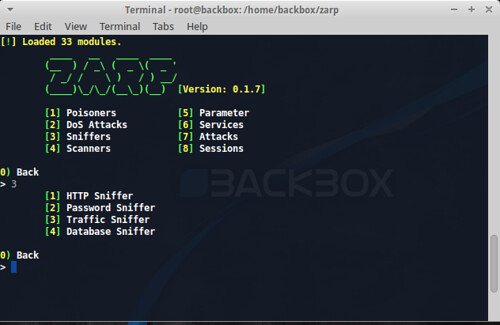
Zarp is a network attack tool centred around the exploitation of local networks. This does not include system exploitation, but rather abusing networking protocols and stacks to take over, infiltrate, and knock out. Sessions can be managed to quickly poison and sniff multiple systems at once, dumping sensitive information automatically or to the attacker directly.  

Various sniffers are included to automatically parse usernames and passwords from various protocols, as well as view HTTP traffic and more. DoS attacks are included to knock out various systems and applications. These tools open up the possibility for very complex attack scenarios on live networks quickly, cleanly, and quietly.

Features

zarp has around 30+ modules grouped into categories of attack and has multiple functionalities under each group:
  • Poisoners
  • Denial of Service
  • Sniffers
  • Scanners
  • Services
  • Parameter
  • Attacks

HOW TO INSTALL 

zarp is intended to be as dependency-free as possible. When available, zarp has opted to use pure or native Python implementations over requiring or importing huge libraries. Even as such, zarp requires the following to run:
  • Linux
  • Python 2.7.x
  • Scapy (packaged with zarp)
It is also recommended that user’s have the following installed for access to specific modules:
  • airmon-ng suite (for all your wireless cracking needs)
  • tcpdump
  • libmproxy (packaged with zarp)
  • paramiko (SSH service)
  • nfqueue-bindings (packet modifier) 


Zarp - Network Attack Tool

Usage

The Future

The long-term goal of this network attack tool zarp is to become the master command center of a network; to provide a modular, well-defined framework that provides a powerful overview and in-depth analysis of an entire network. This will come to light with the future inclusion of a web application front-end, which acts as the television screen, whereas the CLI interface will be the remote. This will provide network topology reports, host relationships, and more. zarp aims to be your window into the potential exploitability of a network and its hosts, not an exploitation platform itself; it is the manipulation of relationships and trust felt within local intranets.
 Download link : https://goo.gl/QvCcrf