• Top secret PRISM program claims direct access to servers of firms including Google, Facebook and Apple • Companies deny any knowledge of program in operation since 2007
A slide depicting the top-secret PRISM program
The National Security Agency has obtained direct access to the systems of Google, Facebook, Apple and other US internet giants, according to a top secret document obtained by the Guardian.
The
NSA access is part of a previously undisclosed program called PRISM,
which allows officials to collect material including search history, the
content of emails, file transfers and live chats, the document says.
The
Guardian has verified the authenticity of the document, a 41-slide
PowerPoint presentation – classified as top secret with no distribution
to foreign allies – which was apparently used to train intelligence
operatives on the capabilities of the program. The document claims
"collection directly from the servers" of major US service providers.
Although
the presentation claims the program is run with the assistance of the
companies, all those who responded to a Guardian request for comment on
Thursday denied knowledge of any such program.
In a statement,
Google said: "Google cares deeply about the security of our users' data.
We disclose user data to government in accordance with the law, and we
review all such requests carefully. From time to time, people allege
that we have created a government 'back door' into our systems, but
Google does not have a back door for the government to access private
user data."
Several senior tech executives insisted that they had
no knowledge of PRISM or of any similar scheme. They said they would
never have been involved in such a program. "If they are doing this,
they are doing it without our knowledge," one said.
An Apple spokesman said it had "never heard" of PRISM.
The
NSA access was enabled by changes to US surveillance law introduced
under President Bush and renewed under Obama in December 2012.
The program facilitates extensive, in-depth surveillance on live
communications and stored information. The law allows for the targeting
of any customers of participating firms who live outside the US, or
those Americans whose communications include people outside the US.
It also opens the possibility of communications made entirely within the US being collected without warrants.
Disclosure of the PRISM program follows a leak to the Guardian on Wednesday of a top-secret court order compelling telecoms provider Verizon to turn over the telephone records of millions of US customers.
The
participation of the internet companies in PRISM will add to the
debate, ignited by the Verizon revelation, about the scale of
surveillance by the intelligence services. Unlike the collection of
those call records, this surveillance can include the content of
communications and not just the metadata.
Some of the world's
largest internet brands are claimed to be part of the
information-sharing program since its introduction in 2007. Microsoft – which is currently running an advertising campaign with the slogan "Your privacy is our priority" – was the first, with collection beginning in December 2007.
It
was followed by Yahoo in 2008; Google, Facebook and PalTalk in 2009;
YouTube in 2010; Skype and AOL in 2011; and finally Apple, which joined
the program in 2012. The program is continuing to expand, with other
providers due to come online.
Collectively, the companies cover the vast majority of online email, search, video and communications networks.
The extent and nature of the data collected from each company varies.
Companies
are legally obliged to comply with requests for users' communications
under US law, but the PRISM program allows the intelligence services
direct access to the companies' servers. The NSA document notes the
operations have "assistance of communications providers in the US".
The
revelation also supports concerns raised by several US senators during
the renewal of the Fisa Amendments Act in December 2012, who warned
about the scale of surveillance the law might enable, and shortcomings
in the safeguards it introduces.
When the FAA was first enacted,
defenders of the statute argued that a significant check on abuse would
be the NSA's inability to obtain electronic communications without the
consent of the telecom and internet companies that control the data. But
the PRISM program renders that consent unnecessary, as it allows the
agency to directly and unilaterally seize the communications off the
companies' servers.
A chart prepared by the NSA, contained within
the top-secret document obtained by the Guardian, underscores the
breadth of the data it is able to obtain: email, video and voice chat,
videos, photos, voice-over-IP (Skype, for example) chats, file
transfers, social networking details, and more. The document is recent, dating to April 2013. Such a
leak is extremely rare in the history of the NSA, which prides itself on
maintaining a high level of secrecy.
The PRISM program allows the
NSA, the world's largest surveillance organisation, to obtain targeted
communications without having to request them from the service providers
and without having to obtain individual court orders.
With this
program, the NSA is able to reach directly into the servers of the
participating companies and obtain both stored communications as well as
perform real-time collection on targeted users.
The presentation
claims PRISM was introduced to overcome what the NSA regarded as
shortcomings of Fisa warrants in tracking suspected foreign terrorists.
It noted that the US has a "home-field advantage" due to housing much of
the internet's architecture. But the presentation claimed "Fisa
constraints restricted our home-field advantage" because Fisa required
individual warrants and confirmations that both the sender and receiver
of a communication were outside the US.
"Fisa was broken because
it provided privacy protections to people who were not entitled to
them," the presentation claimed. "It took a Fisa court order to collect
on foreigners overseas who were communicating with other foreigners
overseas simply because the government was collecting off a wire in the United States. There were too many email accounts to be practical to seek Fisas for all."
The
new measures introduced in the FAA redefines "electronic surveillance"
to exclude anyone "reasonably believed" to be outside the USA – a
technical change which reduces the bar to initiating surveillance.
The
act also gives the director of national intelligence and the attorney
general power to permit obtaining intelligence information, and
indemnifies internet companies against any actions arising as a result
of co-operating with authorities' requests.
In short, where
previously the NSA needed individual authorisations, and confirmation
that all parties were outside the USA, they now need only reasonable
suspicion that one of the parties was outside the country at the time of
the records were collected by the NSA.
The document also shows
the FBI acts as an intermediary between other agencies and the tech
companies, and stresses its reliance on the participation of US internet
firms, claiming "access is 100% dependent on ISP provisioning".
In the document, the NSA hails the PRISM program as "one of the most valuable, unique and productive accesses for NSA".
It
boasts of what it calls "strong growth" in its use of the PRISM program
to obtain communications. The document highlights the number of
obtained communications increased in 2012 by 248% for Skype – leading
the notes to remark there was "exponential growth in Skype reporting;
looks like the word is getting out about our capability against Skype".
There was also a 131% increase in requests for Facebook data, and 63%
for Google.
The NSA document indicates that it is planning to add
Dropbox as a PRISM provider. The agency also seeks, in its words, to
"expand collection services from existing providers".
The
revelations echo fears raised on the Senate floor last year during the
expedited debate on the renewal of the FAA powers which underpin the
PRISM program, which occurred just days before the act expired.
Senator
Christopher Coons of Delaware specifically warned that the secrecy
surrounding the various surveillance programs meant there was no way to
know if safeguards within the act were working.
"The problem is:
we here in the Senate and the citizens we represent don't know how well
any of these safeguards actually work," he said.
"The law doesn't
forbid purely domestic information from being collected. We know that at
least one Fisa court has ruled that the surveillance program violated
the law. Why? Those who know can't say and average Americans can't
know."
Other senators also raised concerns. Senator Ron Wyden of
Oregon attempted, without success, to find out any information on how
many phone calls or emails had been intercepted under the program.
When
the law was enacted, defenders of the FAA argued that a significant
check on abuse would be the NSA's inability to obtain electronic
communications without the consent of the telecom and internet companies
that control the data. But the PRISM program renders that consent
unnecessary, as it allows the agency to directly and unilaterally seize
the communications off the companies' servers.
When the NSA
reviews a communication it believes merits further investigation, it
issues what it calls a "report". According to the NSA, "over 2,000
PRISM-based reports" are now issued every month. There were 24,005 in
2012, a 27% increase on the previous year.
In total, more than 77,000 intelligence reports have cited the PRISM program.
Jameel
Jaffer, director of the ACLU's Center for Democracy, that it was
astonishing the NSA would even ask technology companies to grant direct
access to user data.
"It's shocking enough just that the NSA is
asking companies to do this," he said. "The NSA is part of the military.
The military has been granted unprecedented access to civilian
communications.
"This is unprecedented militarisation of domestic
communications infrastructure. That's profoundly troubling to anyone who
is concerned about that separation."
A senior administration
official said in a statement: "The Guardian and Washington Post articles
refer to collection of communications pursuant to Section 702 of the
Foreign Intelligence Surveillance Act. This law does not allow the
targeting of any US citizen or of any person located within the United
States.
"The program is subject to oversight by the Foreign
Intelligence Surveillance Court, the Executive Branch, and Congress. It
involves extensive procedures, specifically approved by the court, to
ensure that only non-US persons outside the US are targeted, and that
minimize the acquisition, retention and dissemination of incidentally
acquired information about US persons.
"This program was recently reauthorized by Congress after extensive hearings and debate.
"Information
collected under this program is among the most important and valuable
intelligence information we collect, and is used to protect our nation
from a wide variety of threats.
"The Government may only use
Section 702 to acquire foreign intelligence information, which is
specifically, and narrowly, defined in the Foreign Intelligence
Surveillance Act. This requirement applies across the board, regardless
of the nationality of the target."
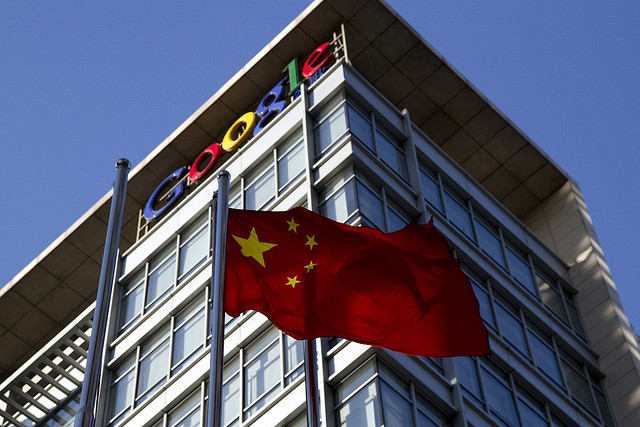
Chinese
hackers who breached Google in 2010 are responsible for the recent
violation to Google Company’s Surveillance Database according officials
revelations.
Google data breach is reality and Google Company’s Surveillance Database has been violated by the same hackers who breached Google’network in 2010,
the attackers have obtained the access to the company’s tracking system
for management of surveillance requests from law enforcement.
The news has been published by the Washington Post and confirmed the voices on the Google data breach.
The database hacked is used by Google company to archive the court
orders submitted by law enforcement who are investigating on a user’s
profile, but the repository also includes classified Foreign
Intelligence Surveillance Act (FISA) orders that are used in foreign intelligence surveillance investigations.
FISA is a US law which outlines practices for the physical and
electronic surveillance and “collection of “foreign intelligence
information” between “foreign powers” and “agents of foreign powers”,
“the sections of FISA authorizing electronic surveillance and physical
searches without a court order specifically exclude their application to
groups engaged in international terrorism. “
The Google’s database contained precious information on surveillance
activities conducted during the last years, it’s clear the purpose of
the attack, it was arranged to gather information on law enforcement and
intelligence agency’s investigation on Chinese intelligence operatives in the US, a former US official confirmed to the Washington Post it:
“Knowing that you were subjects of an investigation
allows them to take steps to destroy information, get people out of the
country,”
The Post states:
“The breach appears to have been aimed at unearthing
the identities of Chinese intelligence operatives in the United States
who may have been under surveillance by American law enforcement
agencies.”
In 2010 numerous companies were hacked by Chinese hackers, including
Adobe and many other financial institutions and defense contractors,
with a series of sophisticated cyber attacks. The attackers stolen from
Google source code and also tried to access to the Gmail accounts of Tibetan activists.
The hackers that targeted Google in December also hit 33 other companies using a zero-day vulnerability
in Adobe Reader to deliver malware to the victims and steal
source-code management systems to obtain the access to company source
code as well as to modify it to make customers who use the application
vulnerable to attack.
The Google data breach was originated in China, Secretary of State
Hillary Clinton publicly condemned the intrusion
requesting for the Chinese Government to give information on the attack.
Google hasn’t confirmed the impairment of its systems for processing
law enforcement surveillance requests, but announced to stop
collaborating with Chinese authorities for censoring Google search results in that country.
Google isn’t unique victims of this new wave of attacks, last month, a
senior Microsoft official denounced that Chinese hackers had targeted
the company’s systems having the same function of Google Surveillance DB
about the same time that Google’s was breached.
“What we found was the attackers were actually looking for the accounts that we had lawful wiretap orders on,” David W. Aucsmith,
senior director of Microsoft’s Institute for Advanced Technology in
Governments, said at a conference near Washington, according to a
recording of his remarks. “If you think about this, this is brilliant
counterintelligence,” he said in the address, which was first reported by
the online magazine CIO.com. “You have two choices: If you want to find
out if your agents, if you will, have been discovered, you can try to
break into the FBI to find out that way. Presumably that’s difficult. Or
you can break into the people that the courts have served paper on and see if you can find it that way. That’s essentially what we think they were trolling for, at least in our case.”
According the Washington Post, Justice Department faced
with Google resistance to show evidence of the attacks providing full
access to internal logs and to authorize a further forensic
investigation of the breach … It is still unclear what Google provided
to the investigators.
Michael M. DuBose, former chief of the Justice Department’s Computer
Crime and Intellectual Property Section, commented the attacks defining
them a wake-up call for the government that the overall security and
effectiveness of lawful interception and undercover operations is
dependent in large part on security standards in the private sector.
“Those,” “clearly need strengthening.” DuBose said,
The incidents raise once again the need to share information on cyber
attacks and data breaches, incidents like these are clear indications
of ongoing sophisticated intelligence operations.
Security researchers have found a proof-of-concept attack that appears to be the first true viral malware approach for compromising OS X.
The malware is called "Clampzok.A" and is a cross-platform malware
package that alters the binary files on an affected system so when
executed, the binary will infect neighboring binary files.
The malware is written in assembly code, and was originally released
in 2006 for Windows and Linux systems, but was recently updated to
affect 32-bit Mach-O binary files in OS X machines.
Unlike Trojan horses, spyware, and adware that hide in one location
on the system and persistently run to steal information or otherwise be a
nuisance, viral malware attempts to spread itself around the system. Of
these, a form known as a worm will try to replicate itself, but does
not infect otherwise healthy files. The classic virus, by contrast, will
inject itself into the compiled code of an executable or into the
structure of a file, modifying it significantly so that when the file is
read, the virus is executed and further injects itself around the
system, wreaking havoc on the system's ability to function.
This latest malware shows promise to do just that.
When infected, the virus will modify the __PAGEZERO segment of a
healthy binary so it holds the virus code. With other modifications to
this segment the virus enables both read and execution ability on this
code. Next, the virus alters the command "LC_UNIXTHREAD" in the binary
so it points to the location of the virus instead of the desired
execution point of the binary file.
When the binary is then executed, the virus code will run and search
for additional 32-bit binary files in the same environment as the
infected one, and attempt the injection on them. The malware tries to
target the BSD tools and other programs stored in the /bin and /usr/bin
directories on OS X systems.
In this manner, if one executes simple terminal commands on an affected system, then other terminal tools could get infected.
This development marks one of the first such viral attacks that can
affect the OS X platform; however, it does have its limitations, both in
current function and in its ability to hide. For one, the attack only
works on 32-bit Mach-O binary files. While there are still plenty of
32-bit programs for OS X, recent versions are migrating to 64-bit code.
In addition, if a system is infected with malware that uses this mode
of attack, then it will be easily detectable since a scanner simply
needs to check for the read and execute ability on the __PAGEZERO
segment of the binary. If this exists, then the binary has been
compromised and can be easily quarantined or otherwise flagged.
Furthermore, this attack will break code-signed programs, so any that
have a valid signature (i.e.those from the
Mac App Store) will no longer work if infected.
Overall, while this development does outline a true viral attack on
OS X, it is just a proof of concept effort, meaning it is not used in
any known malware on OS X. Additionally, it is so far quite limited in
scope, and easy to detect. Does this mean you need to lock down your
system? Not at all. However, it may be wise to simply be mindful that
malware efforts are ongoing for the Mac platform, and among the various
Trojan horse attempts, even viral breakthroughs are occurring.
Security people sure have it good. The United States Bureau of Labor
Statistics tells us that in 2012, self-described information security
professionals experienced 0.9% unemployment
– a sliver of the roughly 8% national average. The Bureau projects 22%
job growth in InfoSec by 2020. Granted, even the BLS admits their
numbers aren’t to be taken as gospel, but that’s only because they couldn’t find enough security professionals for a representative sample size. The Pentagon alone plans to add about 4,000 employees
to the Defense Department’s Cyber Command. For organizations in the
private sector, recruitment of security talent has become such a
priority it’s a full-time job. I should know.
With this kind of demand for their skills, you’d think security
professionals could simply waltz into any company they like, find
perfect jobs ideally matching their backgrounds, and write their own
checks.
However, a serious disconnect exists between the desperate need for
security talent and the hiring behaviors of many organizations. Human
resources departments still release job descriptions with little or no
information about the actual day-to-day work to be performed. The
titles aren’t much better, when a “security analyst” can be anything
from a DLP implementation engineer to an application penetration tester.
Understaffed and over-utilized hiring managers don’t have time to
conduct searches themselves, but routinely express dissatisfaction with
the quality of candidate their corporate recruiters find. And it
figures: HR isn’t incented to know about ethical hacking, risk
assessments or malware reversing, or how to tell the difference between a
keyword-rich résumé and the best technical and cultural fit for their
security organization.
This disconnect creates fear, uncertainty and doubt, or FUD,
on the part of both talent-hungry organizations and those elite
individuals who command the best information security jobs. Companies
know they must attract security experts; candidates know their skills
are in high demand. And yet InfoSec hiring has become a problem of
distribution, like world oil supply or food to the needy: the resources
are there, but because of FUD, they’re not being intelligently routed to
the places they’re needed. Companies fear the risk
they assume in remaining short of security staff (and they should), but
they’re uncertain about how to better attract talent and doubt they’ll
be able to do so. Candidates fear (and loathe)
calls from recruiters who don’t understand what they do; vague,
incomprehensible and sometimes impossible job postings make them
uncertain as to whether to pursue new opportunities, so when they find a
role where they’re relatively happy, they doubt they’ll want to leave
anytime soon. The process stagnates and the demand isn’t supplied.
Don’t succumb to FUD in your job search or hiring process. If you’re a
candidate for a new role, work with recruiters and hiring managers at
organizations that duly value candidate experience and finding the ideal
match for the job – not just anyone with the right acronym on her
résumé. If you’re looking to hire security talent, prioritize best
practices in InfoSec hiring. Certainly be aware that you have to move
fast, that you’re competing with literally every major organization for
talent, and that you cannot afford to treat security talent as a “nice
to have” competency in your company. Then realize that streamlining and clarifying your recruitment process will only help you in reducing time-to-hire for the security experts you need. Take a deep breath, smile, and cut the FUD.
In March, readers followed along as Nate Anderson,
Ars deputy editor and a self-admitted newbie to password cracking,
downloaded a list of more than 16,000 cryptographically hashed
passcodes. Within a few hours, he deciphered almost half of them.
The moral of the story: if a reporter with zero training in the ancient
art of password cracking can achieve such results, imagine what more
seasoned attackers can do.
Imagine no more. We asked three cracking experts to attack the same
list Anderson targeted and recount the results in all their color and
technical detail Iron Chef
style. The results, to say the least, were eye opening because they
show how quickly even long passwords with letters, numbers, and symbols
can be discovered.
The list contained 16,449 passwords converted into hashes using the MD5 cryptographic hash function.
Security-conscious websites never store passwords in plaintext.
Instead, they work only with these so-called one-way hashes, which are
incapable of being mathematically converted back into the letters,
numbers, and symbols originally chosen by the user. In the event of a
security breach that exposes the password data, an attacker still must
painstakingly guess the plaintext for each hash—for instance, they must
guess that "5f4dcc3b5aa765d61d8327deb882cf99" and
"7c6a180b36896a0a8c02787eeafb0e4c" are the MD5 hashes for "password" and
"password1" respectively. (For more details on password hashing, see
the earlier Ars feature "Why passwords have never been weaker—and crackers have never been stronger.")
While Anderson's 47-percent success rate is impressive, it's
miniscule when compared to what real crackers can do, as Anderson
himself made clear. To prove the point, we gave them the same list and
watched over their shoulders as they tore it to shreds. To put it
mildly, they didn't disappoint. Even the least successful cracker of our
trio—who used the least amount of hardware, devoted only one hour, used
a tiny word list, and conducted an interview throughout the
process—was able to decipher 62 percent of the passwords. Our top
cracker snagged 90 percent of them.
The Ars password team included a developer of cracking software, a
security consultant, and an anonymous cracker. The most thorough of the
three cracks was carried out by Jeremi Gosney, a password expert with Stricture Consulting Group. Using a commodity computer with a single AMD Radeon 7970 graphics card, it took him 20 hours to crack 14,734 of the hashes, a 90-percent success rate. Jens Steube, the lead developer behind oclHashcat-plus,
achieved impressive results as well. (oclHashcat-plus is the freely
available password-cracking software both Anderson and all crackers in
this article used.) Steube unscrambled 13,486 hashes (82 percent) in a
little more than one hour, using a slightly more powerful machine that
contained two AMD Radeon 6990 graphics cards.
A third cracker who goes by the moniker radix deciphered 62 percent of
the hashes using a computer with a single 7970 card—also in about one
hour. And he probably would have cracked more had he not been peppered
with questions throughout the exercise.
The list of "plains," as many crackers refer to deciphered hashes,
contains the usual list of commonly used passcodes that are found in
virtually every breach involving consumer websites. "123456," "1234567,"
and "password" are there, as is "letmein," "Destiny21," and
"pizzapizza." Passwords of this ilk are hopelessly weak. Despite the
additional tweaking, "p@$$word," "123456789j," "letmein1!," and
"LETMEin3" are equally awful. But sprinkled among the overused and
easily cracked passcodes in the leaked list are some that many readers
might assume are relatively secure. ":LOL1313le" is in there, as are
"Coneyisland9/," "momof3g8kids," "1368555av," "n3xtb1gth1ng,"
"qeadzcwrsfxv1331," "m27bufford," "J21.redskin," "Garrett1993*," and
"Oscar+emmy2."
A screenshot showing a small sampling of cracked passwords.
As big as the word lists that all three crackers in this article
wielded—close to 1 billion strong in the case of Gosney and Steube—none
of them contained "Coneyisland9/," "momof3g8kids," or the more than
10,000 other plains that were revealed with just a few hours of effort.
So how did they do it? The short answer boils down to two variables: the
website's unfortunate and irresponsible use of MD5 and the use of
non-randomized passwords by the account holders.
Life in the fast lane
"These are terrible passwords," radix, who declined to give his real
name, told Ars just a few minutes into run one of his hour-long cracking
session. "There's probably not a complexity requirement for them. The
hashing alone being MD5 tells me that they really don't care about their
passwords too much, so it's probably some pre-generated site."
Like SHA1, SHA3, and most other algorithms, MD5 was designed to
convert plaintext into hashes, also known as "message digests," quickly
and with a minimal amount of computation. That works in the favor of
crackers. Armed with a single graphics processor, they can cycle through
more than eight billion password combinations each second when
attacking "fast" hashes. By contrast, algorithms specifically designed
to protect passwords require significantly more time and computation.
For instance, the SHA512crypt function included by default in Mac OS X
and most Unix-based operating systems passes text through 5,000 hashing
iterations. This hurdle would limit the same one-GPU cracking system to
slightly less than 2,000 guesses per second. Examples of other similarly
"slow" hashing algorithms include bcrypt, scrypt, and PBKDF2.
The other variable was the account holders' decision to use memorable
words. The characteristics that made "momof3g8kids" and "Oscar+emmy2"
easy to remember are precisely the things that allowed them to be
cracked. Their basic components—"mom," "kids," "oscar," "emmy," and
numbers—are a core part of even basic password-cracking lists. The
increasing power of hardware and specialized software makes it trivial
for crackers to combine these ingredients in literally billions of
slightly different permutations. Unless the user takes great care,
passwords that are easy to remember are sitting ducks in the hands of
crackers.
What's more, like the other two crackers profiled in this article,
radix didn't know where the password list was taken from, eliminating
one of the key techniques crackers use when deciphering leaked hashes.
"If I knew the site, I would go there and find out what the requirements
are," he said. The information would have allowed radix to craft custom
rule sets targeted at the specific hashes he was trying to crack.
Anatomy of a crack
The longer answer to how these relatively stronger passwords were
revealed requires comparing and contrasting the approaches of the three
crackers. Because their equipment and the amount of time they devoted to
the exercise differed, readers shouldn't assume one cracker's technique
was superior to those of the others. That said, all three cracks
resembled video games where each successive level is considerably harder
than the last. The first stage of each attack typically cracked in
excess of 50 percent of the hashes, with each stage that came later
cracking smaller and smaller percentages. By the time they got to the
latest rounds, they considered themselves lucky to get more than a few
hundred plains.
True to that pattern, Gosney's first stage cracked 10,233 hashes, or
62 percent of the leaked list, in just 16 minutes. It started with a
brute-force crack for all passwords containing one to six characters,
meaning his computer tried every possible combination starting with "a"
and ending with "//////." Because guesses have a maximum length of six
and are comprised of 95 characters—that's 26 lower-case letters, 26
upper-case letters, 10 digits, and 33 symbols—there are a manageable
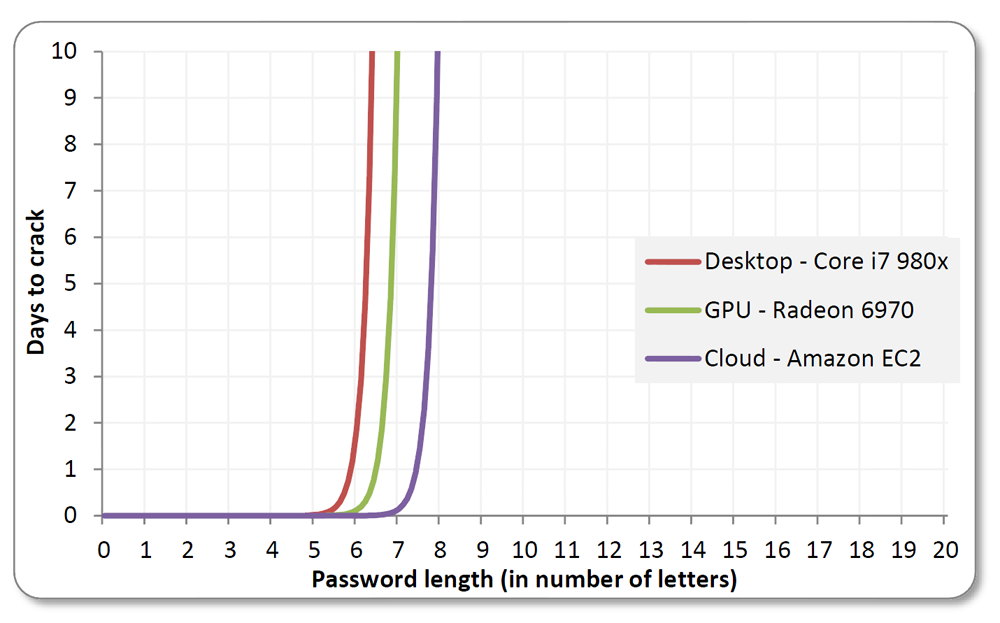
number of total guesses. This is calculated by adding the sum of 956 + 955 + 954 + 953 + 952 + 95. It took him just two minutes and 32 seconds to complete the round, and it yielded the first 1,316 plains of the exercise.
Beyond a length of six, however, Gosney was highly selective about
the types of brute-force attacks he tried. That's because of the
exponentially increasing number of guesses each additional character
creates. While it took only hours to brute-force all passwords from one
to six characters, it would have taken Gosney days, weeks, or even years
to brute-force longer passwords. Robert Graham, the CEO of Errata
Security who has calculated the requirements, refers to this limitation
as the "exponential wall of brute-force cracking."
Enlarge/
Brute-force cracks work well against shorter passwords. The technique
can take days or months for longer passcodes, even when using Amazon's
cloud-based EC2 service.
Recognizing these limits, Gosney next brute-force cracked all
passwords of length seven or eight that contained only lower letters.
That significantly reduced the time required and still cracked 1,618
hashes. He tried all passwords of length seven or eight that contained
only upper letters to reveal another 708 plains. Because their
"keyspace" was the sum of 268 + 267, each of these
steps was completed in 41 seconds. Next, he brute-forced all passwords
made up solely of numbers from one to 12 digits long. It cracked 312
passcodes and took him three minutes and 21 seconds.
It was only then that Gosney turned to his word lists, which he has
spent years fine tuning. Augmenting the lists with the "best64" rule set
built into Hashcat, he was able to crack 6,228 hashes in just nine
minutes and four seconds. To complete stage one, he ran all the plains
he had just captured in the previous rounds through a different rule set
known as "d3ad0ne" (named after its creator who is a recognized password expert). It took one second to complete and revealed 51 more plains.
"Normally I start by brute-forcing all characters from length one to
length six because even on a single GPU, this attack completes nearly
instantly with fast hashes," Gosney explained in an e-mail. He
continued:
And because I can brute-force this really quickly, I have
all of my wordlists filtered to only include words that are at least
six chars long. This helps to save disk space and also speeds up
wordlist-based attacks. Same thing with digits. I can just brute-force
numerical passwords very quickly, so there are no digits in any of my
wordlists. Then I go straight to my wordlists + best64.rule since those
are the most probable patterns, and larger rule sets take much longer to
run. Our goal is to find the most plains in the least amount of time,
so we want to find as much low-hanging fruit as possible first.
Cracking the weakest passwords first is especially helpful when
hashes contain cryptographic salt. Originally devised to thwart rainbow
tables and other types of precomputed techniques, salting appends random
characters to each password before it is hashed. Besides defeating
rainbow tables, salting slows down brute-force and dictionary attacks
because hashes must be cracked one at a time rather than all of them at
once.
But the thing about salting is this: it slows down cracking only by a
multiple of the number of unique salts in a given list. That means the
benefit of salting diminishes with each cracked hash. By cracking the
weakest passwords as quickly as possible first (an optimization offered
by Hashcat) crackers can greatly diminish the minimal amount of
protection salting might provide against cracking. Of course, none of
this applies in this exercise since the leaked MD5 wasn't salted.
With 10,233 hashes cracked in stage one, it was time for stage two, which consisted of a series of hybrid attacks.
True to the video game analogy mentioned earlier, this second stage of
attacks took considerably longer than the first one and recovered
considerably fewer plains—to be exact, five hours and 12 minutes
produced 2,702 passwords.
As the name implies, a hybrid attack marries a dictionary attack with
a brute-force attack, a combination that greatly expands the reach of a
well-honed word list while keeping the keyspace to a manageable length.
The first round of this stage appended all possible two-characters
strings containing digits or symbols to the end of each word in his
dictionary. It recovered 585 plains and took 11 minutes and 25 seconds
to run. Round two appended all possible three-character strings
containing digits or symbols. It cracked 527 hashes and required 58
minutes to complete. The third round, which appended all four-digit
number strings, took 25 minutes and recovered 435 plains. Round four
appended all possible strings containing three lower-case letters and
digits and acquired 451 more passwords.
As fruitful as these attacks were, Gosney said they were handicapped by his use of a single graphics card for this exercise.
"For example, you'll notice that when I was doing hybrid attacks, I
appended 2-3 digits/special but then only did digits with length 4," he
explained. "This is because doing digits/special for length 4 would have
taken a really long time with just one GPU, so I skipped it. Same with
when I started appending lower alpha/digits, I only did length 3 because
length 4 would have taken too long with just one GPU."
No doubt, Gosney could have attacked much larger keyspaces had he used the monster 25-GPU cluster he unveiled in December.
Because the graphics cards in the five-server system scale almost
linearly, it's able to harness almost all of their combined power. As a
result, it can achieve 350 billion guesses per second when cracking
password hashes generated by Microsoft's NTLM algorithm. And it could
generate similar results when going up against MD5 and other fast hash
functions.
The remaining hybrid attacks in stage two continued in the same vein.
By the time it was completed, he had cracked a total of 12,935 hashes,
or 78.6 percent of the list, and had spent a total of just 5 hours and
28 minutes doing it.
One of the things Gosney and other crackers have found is that
passwords for a particular site are remarkably similar, despite being
generated by users who have never met each other. After cracking such a
large percentage of hashes from this unknown site, the next step was to
analyze the plains and mimic the patterns when attempting to guess the
remaining passwords. The result is a series of statistically generated
brute-force attacks based on a mathematical system known as Markov chains.
Hashcat makes it simple to implement this method. By looking at the
list of passwords that already have been cracked, it performs
probabilistically ordered, per-position brute-force attacks. Gosney
thinks of it as an "intelligent brute-force" that uses statistics to
drastically limit the keyspace.
Where a classic brute-force tries "aaa," "aab," "aac," and so on, a
Markov attack makes highly educated guesses. It analyzes plains to
determine where certain types of characters are likely to appear in a
password. A Markov attack with a length of seven and a threshold of 65
tries all possible seven-character passwords with the 65 most likely
characters for each position. It drops the keyspace of a classic
brute-force from 957 to 657, a benefit that saves
an attacker about four hours. And since passwords show surprising
uniformity when it comes to the types of characters used in each
position—in general, capital letters come at the beginning, lower-case
letters come in the middle, and symbols and numbers come at the
end—Markov attacks are able crack almost as many passwords as a straight
brute-force.
"This is where your attack plan deviates from the standard and
becomes unique, because now you're doing site-specific attacks," Gosney
said. "From there, if you start hitting upon any interesting patterns,
you just start chasing those patterns down the rabbit hole. Once you've
fully exploited one pattern you move on to the next."
In all, it took Gosney 14 hours and 59 minutes to complete this third
stage, which besides Markov attacks included several other custom
wordlists combined with rules. Providing further evidence of the law of
diminishing returns that dictates password cracking, it yielded 1,699
more passwords. It's interesting to note that the increasing difficulty
is experienced even within this last step itself. It took about three
hours to cover the first 962 plains in this stage and 12 hours to get
the remaining 737.
The other two password experts who cracked this list used many of the
same techniques and methods, although not in the same sequence and with
vastly different tools. The only wordlist used by radix, for example,
came directly from the 2009 breach of online games service RockYou.
Because the SQL-injection hack exposed more than 14 million unique
passwords in plaintext, the list represents the largest corpus of
real-world passwords ever to be made public. radix has a much bigger
custom-compiled dictionary, but like a magician who doesn't want to
reveal the secret behind a trick, he kept it under wraps during this
exercise.
Killing hashes
Like Nate Anderson's foray into password cracking, radix was able to
crack 4,900 of the passwords, nearly 30 percent of the haul, solely by
using the RockYou list. He then took the same list, cut the last four
characters off each of the words, and appended every possible four-digit
number to the end. Hashcat told him it would take two hours to
complete, which was longer than he wanted to spend. Even after
terminating the run two after 20 minutes, he had cracked 2,136 more
passcodes. radix then tried brute-forcing all numbers, starting with a
single digit, then two digits, then three digits, and so on (259
additional plains recovered).
He seemed to choose techniques for his additional runs almost at
random. But in reality, it was a combination of experience, intuition,
and possibly a little luck.
"It's all about analysis, gut feelings, and maybe a little magic," he
said. "Identify a pattern, run a mask, put recovered passes in a new
dict, run again with rules, identify a new pattern, etc. If you know the
source of the hashes, you scrape the company website to make a list of
words that pertain to that specific field of business and then
manipulate it until you are happy with your results."
He then ran the 7,295 plains he recovered so far through PACK, short for the Password Analysis and Cracking Toolkit
(developed by password expert Peter Kacherginsky), and noticed some
distinct patterns. A third of them contained eight characters, 19
percent contained nine characters, and 16 percent contained six
characters. PACK also reported that 69 percent of the plains were
"stringdigit" meaning a string of letters or symbols that ended with
numbers. He also noticed that 62 percent of the recovered passwords were
classified as "loweralphanum," meaning they consisted solely of
lower-case letters and numbers.
This information gave him fodder for his next series of attacks. In run 4, he ran a mask attack.
This is similar to the hybrid attack mentioned earlier, and it brings
much of the benefit of a brute-force attack while drastically reducing
the time it takes to run it. The first one tried all possible
combinations of lower-case letters and numbers, from one to six
characters long (341 more plains recovered). The next step would have
been to try all combinations of lower-case letters and numbers with a
length of eight. But that would have required more time than radix was
willing to spend. He then considered trying all passwords with a length
of eight that contained only lower-case letters. Because the attack
excludes upper case letters, the search space was manageable, 268 instead of 528.
With radix's machine, that was the difference between spending a little
more than one minute and six hours respectively. The lower threshold
was still more time than he wanted to spend, so he skipped that step
too.
So radix then shifted his strategy and used some of the rule sets
built into Hashcat. One of them allows Hashcat to try a random
combination of 5,120 rules, which can be anything from swapping each "e"
with a "3," pulling the first character off each word, or adding a
digit between each character. In just 38 seconds the technique recovered
1,940 more passwords.
"That's the thrill of it," he said. "It's kind of like hunting, but
you're not killing animals. You're killing hashes. It's like the
ultimate hide and seek." Then acknowledging the dark side of password
cracking, he added: "If you're on the slightly less moral side of it, it
has huge implications."
Steube also cracked the list of leaked hashes with aplomb. While the
total number of words in his custom dictionaries is much larger, he
prefers to work with a "dict" of just 111 million words and pull out the
additional ammunition only when a specific job calls for it. The words
are ordered from most to least commonly used. That way, a particular run
will crack the majority of the hashes early on and then slowly taper
off. "I wanted it to behave like that so I can stop when things get
slower," he explained.
Early in the process, Steube couldn't help remarking when he noticed one of the plains he had recovered was "momof3g8kids."
"This was some logic that the user had," Steube observed. "But we
didn't know about the logic. By doing hybrid attacks, I'm getting new
ideas about how people build new [password] patterns. This is why I'm
always watching outputs."
The specific type of hybrid attack that cracked that password is known as a combinator attack.
It combines each word in a dictionary with every other word in the
dictionary. Because these attacks are capable of generating a huge
number of guesses—the square of the number of words in the dict—crackers
often work with smaller word lists or simply terminate a run in
progress once things start slowing down. Other times, they combine words
from one big dictionary with words from a smaller one. Steube was able
to crack "momof3g8kids" because he had "momof3g" in his 111 million dict
and "8kids" in a smaller dict.
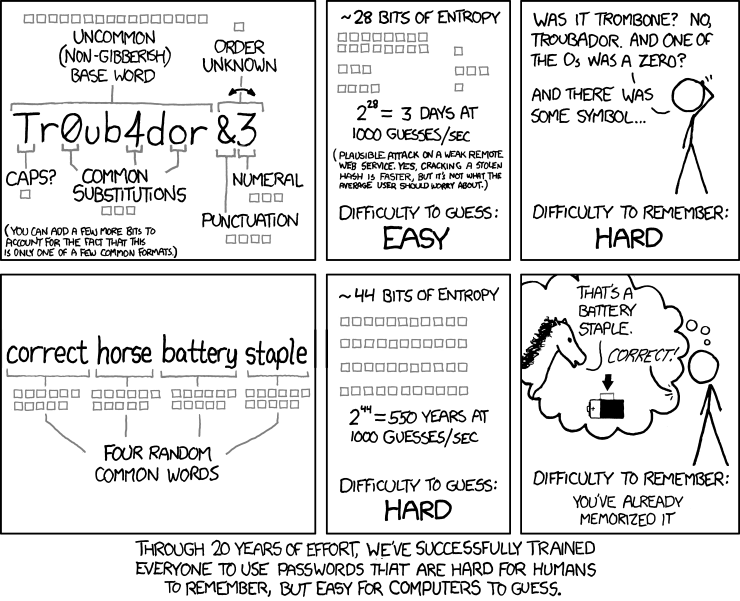
"The combinator attack got it! It's cool," he said. Then referring to the oft-cited xkcd comic, he added: "This is an answer to the batteryhorsestaple thing."
What was remarkable about all three cracking sessions were the types
of plains that got revealed. They included passcodes such as
"k1araj0hns0n," "Sh1a-labe0uf," "Apr!l221973," "Qbesancon321,"
"DG091101%," "@Yourmom69," "ilovetofunot," "windermere2313," "tmdmmj17,"
and "BandGeek2014." Also included in the list: "all of the lights"
(yes, spaces are allowed on many sites), "i hate hackers,"
"allineedislove," "ilovemySister31," "iloveyousomuch,"
"Philippians4:13," "Philippians4:6-7," and "qeadzcwrsfxv1331."
"gonefishing1125" was another password Steube saw appear on his computer
screen. Seconds after it was cracked, he noted, "You won't ever find it
using brute force."
The ease these three crackers had converting hashes into their
underlying plaintext contrasts sharply with the assurances many websites
issue when their password databases are breached. Last month, when
daily coupons site LivingSocial disclosed a hack that exposed names,
addresses, and password hashes for 50 million users, company executives
downplayed the risk.
"Although your LivingSocial password would be difficult to decode, we
want to take every precaution to ensure that your account is secure, so
we are expiring your old password and requesting that you create a new
one," CEO Tim O'Shaughnessy told customers.
In fact, there's almost nothing preventing crackers from deciphering
the hashes. LivingSocial used the SHA1 algorithm, which as mentioned
earlier is woefully inadequate for password hashing. He also mentioned
that the hashes had been "salted," meaning a unique set of bits had been
added to each users' plaintext password before it was hashed. It turns
out that this measure did little to mitigate the potential threat.
That's because salt is largely a protection against rainbow tables and
other types of precomputed attacks, which almost no one ever uses in
real-world cracks. The file sizes involved in rainbow attacks are so
unwieldy that they fell out of vogue once GPU-based cracking became
viable. (LivingSocial later said it's in the process of transitioning to
the much more secure bcrypt function.)
Officials with Reputation.com, a service that helps people and
companies manage negative search results, borrowed liberally from the
same script when disclosing their own password breach
a few days later. "Although it was highly unlikely that these passwords
could ever be decrypted, we immediately changed the password of every
user to prevent any possible unauthorized account access," a company
e-mail told customers.
Both companies should have said that, with the hashes exposed, users
should presume their passwords are already known to the attackers. After
all, cracks against consumer websites typically recover 60 percent to
90 percent of passcodes. Company officials also should have warned
customers who used the same password on other sites to change them
immediately.
To be fair, since both sites salted their hashes, the cracking
process would have taken longer to complete against large numbers of
hashes. But salting does nothing to slow down the cracking of a single
hash and does little to slow down attacks on small numbers of hashes.
This means that certain targeted individuals who used the hacked
sites—for example, bank executives, celebrities, or other people of
particular interest to the attackers—weren't protected at all by
salting.
The prowess of these three crackers also underscores the need for end
users to come up with better password hygiene. Many Fortune 500
companies tightly control the types of passwords employees are allowed
to use to access e-mail and company networks, and they go a long way to
dampen crackers' success.
"On the corporate side, its so different," radix said. "When I'm
doing a password audit for a firm to make sure password policies are
properly enforced, it's madness. You could go three days finding
absolutely nothing."
Websites could go a long way to protect their customers if they
enforced similar policies. In the coming days, Ars will publish a
detailed primer on passwords managers. It will show how to use them to
generate long, random passcodes that are unique to each site. Because
these types of passwords can only be cracked by brute force, they are
the hardest to recover. In the meantime, readers should take pains to
make sure their passwords are a minimum of 11 characters, contain upper-
and lower-case letters, numbers, and letters, and aren't part of a
pattern.
The ease these crackers had in recovering as many as 90 percent of
the hashes they targeted from a real-world breach also exposes the
inability many services experience when trying to measure the relative
strength or weakness of various passwords. A recently launched site from
chipmaker Intel asks users "How strong is your password?," and it
estimated it would take six years to crack the passcode "BandGeek2014". That estimate is laughable given that it was one of the first ones to fall at the hands of all three real-world crackers.
As Ars explained recently,
the problem with password strength meters found on many websites is
they use the total number of combinations required in a brute-force
crack to gauge a password's strength. What the meters fail to account
for is that the patterns people employ to make their passwords memorable
frequently lead to passcodes that are highly susceptible to much more
efficient types of attacks.
"You can see here that we have cracked 82 percent [of the passwords]
in one hour," Steube said. "That means we have 13,000 humans who did not
choose a good password." When academics and some websites gauge
susceptibility to cracking, "they always assume the best possible
passwords, when it's exactly the opposite. They choose the worst."

 The program facilitates extensive, in-depth surveillance on live
communications and stored information. The law allows for the targeting
of any customers of participating firms who live outside the US, or
those Americans whose communications include people outside the US.
The program facilitates extensive, in-depth surveillance on live
communications and stored information. The law allows for the targeting
of any customers of participating firms who live outside the US, or
those Americans whose communications include people outside the US.


 Security researchers have
 In March, readers followed along as


 Posts
Posts