Despite their prevalence,
DDoS
(Distributed Denial of Service) attacks have been erroneously
considered minor attacks by some parts of the security community due
their “limited” duration. Victims of
DDoS attacks are typically forced to interrupt their services for a few hours without any other observable damage.
Recent events, however, have demonstrated that the impact of DDoS
attacks is much more than meets the eye. Not only can these attacks
inflict huge economic losses, they can also have a serious impact on the
reputation and image of the victimized company or organization.
Another worrying trend observed in recent DDoS attacks is that in
addition to targeting web infrastructures, attackers are also trying to
exploit flaws and improper configurations within the Domain Name System
(DNS) infrastructures. Arbor Networks’ 2012 Worldwide Infrastructure
Security Report indicated that 41% of respondents experienced DDoS
attacks against their DNS infrastructure.
Moreover, the targets of a DDoS attack do not fit into a specific
category. Providers of online banking, payment services, email services
and just about every other type of web service provider are prime
candidates.
Similarly, there is no typical profile of an attacker – cyber criminals,
hacktivists and state-sponsored hackers all use similar tactics to hit a large list of targets.
Principal Categories of DDoS Attacks
The security community classifies DDoS attacks as follows:
- Volume Based Attacks –The attacker tries to saturate the
bandwidth of the target’s website by flooding it with a huge quantity of
data. This category includes ICMP floods, UDP floods and other
spoofed-packet floods. This type of attack is very common and simple to
execute using the vast quantity of free tools available on the Internet,
and, as such, is very popular in the hacktivist underground. The magnitude of Volume Based Attacks is measured in bits per second (Bps).
- Protocol Attacks –The attacker’s goal is to saturate the
target’s server resources or those of intermediate communication
equipment (e.g., Load balancers) by exploiting network protocol flaws.
This category includes SYN floods, Ping of Death, fragmented packet
attacks, Smurf DDoS and more. The magnitude of Protocol Attacks is
measured in Packets per second.
- Application Layer (Layer 7) Attacks – Designed to exhaust the
resource limits of Web services, application layer attacks target
specific web applications, flooding them with a huge quantity of HTTP
requests that saturate a target’s resources. Application layer attacks are hard
to detect because they don’t necessarily involve large volumes of
traffic and require fewer network connections than other types of DDoS
techniques. Examples of application layer DDoS attacks include
Slowloris, as well as DDoS attacks that target Apache, Windows, or
OpenBSD vulnerabilities. The magnitude of application layer attacks is
measured in Requests per second.
DDoS Mitigation Solutions – Traditional vs. Cloud-Based
The increase in the magnitude and complexity of DDoS attacks
highlights the need for organizations to adopt proper countermeasures
and mitigation techniques. Naturally, time is of the essence when it
comes to DDoS protection. Prompt DDoS detection is a critical phase of
the mitigation process – the faster security systems can detect a
potential threat, the better the chance of minimizing damage and even
neutralizing the threat.
Firms that provide solutions for DDoS mitigation follow various
approaches to protect their customers. The first step in protecting a
company’s web infrastructure against a DDoS attack is to identify normal
conditions for network traffic. This definition of normal “traffic
patterns” is
necessary baseline for threat detection and alerting. The majority of commercial solutions
provides threshold-based alerting mechanisms that trigger alerts based on the collection of meaningful information from the logs.
Another common detection approach is known as “Layered Filtering,”,
dedicated appliances and software detect and mitigates different types
of attacks in both the network and application layers. Defense
mechanisms which analyze traffic in layers try to detect harmful traffic
and apply filters to block the threats at the specific level. Many
companies also adopt open source software to limit the incoming number
of connections and traffic dimensions.
Traditional DDoS mitigation solutions oversize the network bandwidth
and adopt complex hardware such as firewalls and load balancers. Many
experts consider this approach to be unnecessarily costly and in many
cases ineffective. For this reason, many companies have chosen to adopt a
cloud-based approach to DDoS protection with direct management of DNS
services, enabling them to optimize their response to malicious events.
Another advantage of a cloud-based approach is the reduction of
investment in equipment and infrastructure (
capex) as well as the reduced cost of managing and maintaining typical hardware solutions (
opex).
Key Criteria for Evaluating DDoS Mitigation Solutions
Choosing a DDoS mitigation solution is far from a simple task, given
the numerous alternatives and choices, such as hardware versus software,
appliance versus cloud-based solutions, etc. To simplify your decision
process, the following checklist includes the most important
features/criteria to evaluate before acquiring a new product:
- Capacity of solution in term of protocols supported, analysis path implemented and granularity offered for traffic inspection.
- Support for traffic profiling. Companies offering a variety of
services may wish to define a different policy for each service. Normal
traffic patterns for various services could be substantially different.
For example, analyzing a banking website the traffic related to the
users that simply visit the portal must be differentiated from the one
related to banking customers that access to home banking functions.
- Product flexibility – the possibility to create ad hoc policies and patterns starting from well-known configurations.
- Product scalability – the product should be able to evolve and scale with the changing needs of the buyer.
- Availability of built-in hardware redundancy features
- Availability of an efficient reporting/alerting system. Various
solutions provide very different levels of reports and alerts – these
features should be evaluated with care.
- Reliability – DDoS is a dynamic threat that morphs over time. Be
sure to choose a solution provider that is able to provide continuous
updates and prompt support for its products.
- Bidirectional traffic monitoring – It is important to control both
inbound and outbound traffic to prevent the abuse of network resources
by attackers.
- Product reputation and customer references. This is a crucial aspect
that must take into account the features of product and maintenance
services.
How does the cloud based DDoS mitigation approach work?
As noted earlier, one of most popular mitigation approaches is cloud-based
DDoS mitigation. Such solutions are offered by Incapsula,
Prolexic
and Verisign, among others. Successful mitigation depends on the
ability to monitor and analyze traffic patterns in real time. When a
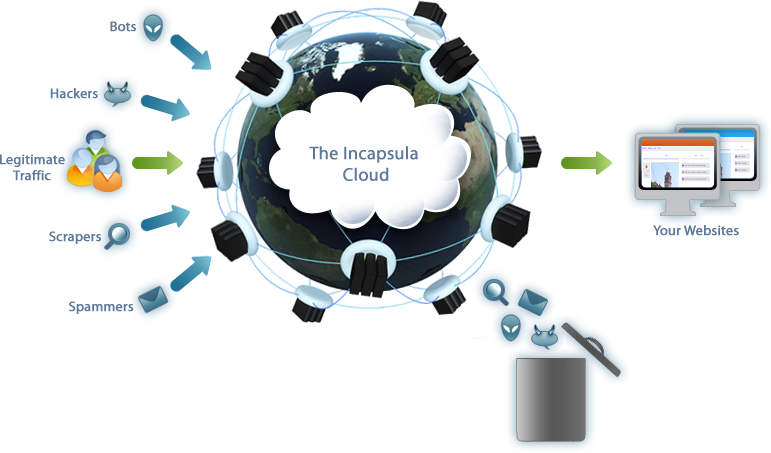
DDoS attack is detected by monitoring systems, the malicious traffic is
redirected from the targeted website to a mitigation architecture
through the cloud. Inbound malicious traffic is sent to the nearest
scrubbing center, where the mitigation solution applies DDoS filtering
and routing techniques to reduce DDoS traffic interference. The clean
traffic is then routed back to the customer’s network. Accordingly, the
capacity of the scrubbing centers and the filtering methods used are
crucial for the provisioning of an efficient DDoS mitigation service.
To get an industry expert’s take on these topics, I contacted
Incapsula, one of the leading providers of DDoS mitigation services.
Incapsula
offers Web Security, DDoS Protection, Failover & Load Balancing on a
Global CDN. The company was spun out of and is financially backed by
Imperva [IMPV], a leading provider of data security solutions. Here are excerpts from my interview with Incapsula’s CEO, Gur Shatz.
What are the key criteria for a successful DDoS mitigation service?
“Well, there are various factors that contribute to a successful DDoS mitigation solution, such as:
- Network size: You need a mitigation service that can
handle the largest possible attack that could come your way. Since
attacks are becoming larger at a disturbing rate, anything below 250Gbps
of network capacity just isn’t enough.
- Automatic detection: There are many ways to launch a
DDoS attack, and sometimes the nature of the attack rather than its size
is what makes mitigation so hard. Take, for example, hit and run
attacks which are short bursts of traffic in random intervals over a
long period of time. A manual mitigation solution that requires users to
turn it on and off on every burst
will throw the IT team into complete havoc. Some solutions, like
Incapsula, offer automatic DDoS mitigation and take full responsibility
for both detection and mitigation of the attack.
- Transparent mitigation: DDoS is about degradation of service. While this can be complete denial
of service, it can also be disruptions. If your DDoS mitigation service
introduces a large rate of false positives or degrades the normal user
experience in any way, the DDoS attack is actually achieving its goal –
even if your service is still up and running. Unless your mitigation
service can offer zero disruption to the normal user experience, you
will not be able to withstand lengthy attacks without damaging business
performance.
- Time and complexity to onboard:
A key factor in a DDoS service is the time it takes to on-board the
service. There are various techniques and setups – the more complex ones
require on‑premise devices and configuration, while the faster ones
require only a simple DNS change. When you are under fire, you’ll
appreciate having chosen a solution that can shield your network from
that attack with minimal time and effort.
- Support: A 24×7 team of experts is an essential part
of a reliable DDoS mitigation service. Being under a DDoS attack is one
of the most frustrating situations for any IT manager. You have
practically no visibility into what is happening, there is nothing you
can do internally and your entire service is
down. You need an expert by your side who can help you understand what
is going on during the attack and get you through it as painlessly as
possible.”
Based on the observation of DDoS attacks against your clients
during the last few months, what are the changes/trends that you are
seeing with respect to attack methods?
“The principal trends that we are observing are:
- Larger and larger network attacks. These large-scale attacks are often using SYN flood and DNS amplifications as their tool of choice.
- Hit and Run attacks. These are smaller scale application layer attacks that don’t last very long, but occur every few days.
This information might be biased, because as a cloud provider, we are
well suited for handling large network attacks. Since our users
typically use our “always on” automatic detection service, it is
reasonable to assume that users with hit and run problems tend to reach
us more than users of other solutions.”
What are the strong points of your Cloud-based solution?
“I believe that our true strengths lie in a number of aspects of our service:
- We offer a cloud based service that can be activated without any
additional hardware, software or other integration requirements. Adding a
website to Incapsula is done through a simple DNS change which allows
us to offer our services to practically anyone regardless of company
size, IT manpower or expertise.
- A large network of more than 300Gbps that can handle practically any attack out there.
- Transparent and automatic mitigation of attacks with no negative
(and in most cases positive) effect on legitimate users’ experience.
- Having a built-in CDN and Web Application Firewall allow our
customers to always be online and automatically mitigate attacks while
improving overall user experience and overall security.”
Whatever solution you choose, you must always consider the trade-off
between costs and benefits. To meet business goals, every company is
increasing its exposure on the Internet and, in parallel, enlarging the
potential surface of attack. At the same time, downtime is no longer
acceptable from a business standpoint for the majority of these
companies.
 Israel
is losing the internet war for chiefly the same reason that France and
Poland fell early in World War II. Israel is fighting a new war using
old methods. The end results are predictable and devastating.
Israel
is losing the internet war for chiefly the same reason that France and
Poland fell early in World War II. Israel is fighting a new war using
old methods. The end results are predictable and devastating. 

 "If it is discovered that Indian laws relating to privacy of information
of ordinary Indian citizens have been violated we would find it
unacceptable," external affairs ministry spokesperson Syed Akbaruddin
said at a media briefing
"If it is discovered that Indian laws relating to privacy of information
of ordinary Indian citizens have been violated we would find it
unacceptable," external affairs ministry spokesperson Syed Akbaruddin
said at a media briefing
 Posts
Posts


